 ×
×
Thread and stitch density are specifications that do not appear in most purchase orders and are not visible in product photographs. They are, however, directly responsible for whether a laptop backpack holds together under daily use or begins to show seam failures within the first year.
Stitch density — measured in stitches per inch (SPI) or stitches per centimeter — determines how many interlocking thread loops hold a seam together. A seam with 8 SPI has twice as many thread interlocks per inch as a seam with 4 SPI. Under load, the higher-density seam distributes stress across more interlocks, reducing the load per interlock and extending seam life.
For load-bearing seams in a laptop backpack — strap attachments, main compartment side seams, base seam — 8–12 SPI is the appropriate range. Below 8 SPI, the seam density is insufficient for sustained load-bearing applications.
For decorative seams and non-load-bearing stitching, 6–8 SPI is acceptable. Running decorative seams at higher density adds cost without meaningful functional benefit.
For edge binding and reinforcement tapes — the finished edges of the bag that prevent fabric fraying — 10–12 SPI is appropriate. Edge binding failures at lower stitch densities create fabric fraying that propagates rapidly into the main panel fabric.
These numbers assume a standard lockstitch on an industrial sewing machine. Chain stitch constructions use different density norms and unravel differently when a thread breaks — a chain-stitched seam at the same visual density as a lockstitch seam is significantly less secure.
Thread weight (called "ticket number" or "Tex" in industry specification) determines thread thickness. Heavier threads (lower ticket number or higher Tex) provide more tensile strength per stitch but require larger needle sizes and produce more visible stitching.
For primary seams on 600D or heavier outer shell fabric, T-70 (Tex 70) or T-90 polyester thread is appropriate. For decorative topstitching, T-50 provides a finer appearance. Using T-30 or lighter thread on load-bearing seams is a cost-cutting move that reduces seam strength by 20–35%.
Polyester thread is the standard for outdoor and bag applications — it has better UV resistance and moisture resistance than cotton thread and does not shrink significantly with washing. Nylon thread offers higher elasticity (useful for seams that flex repeatedly) and higher tensile strength, but costs more and is less UV-stable than polyester.
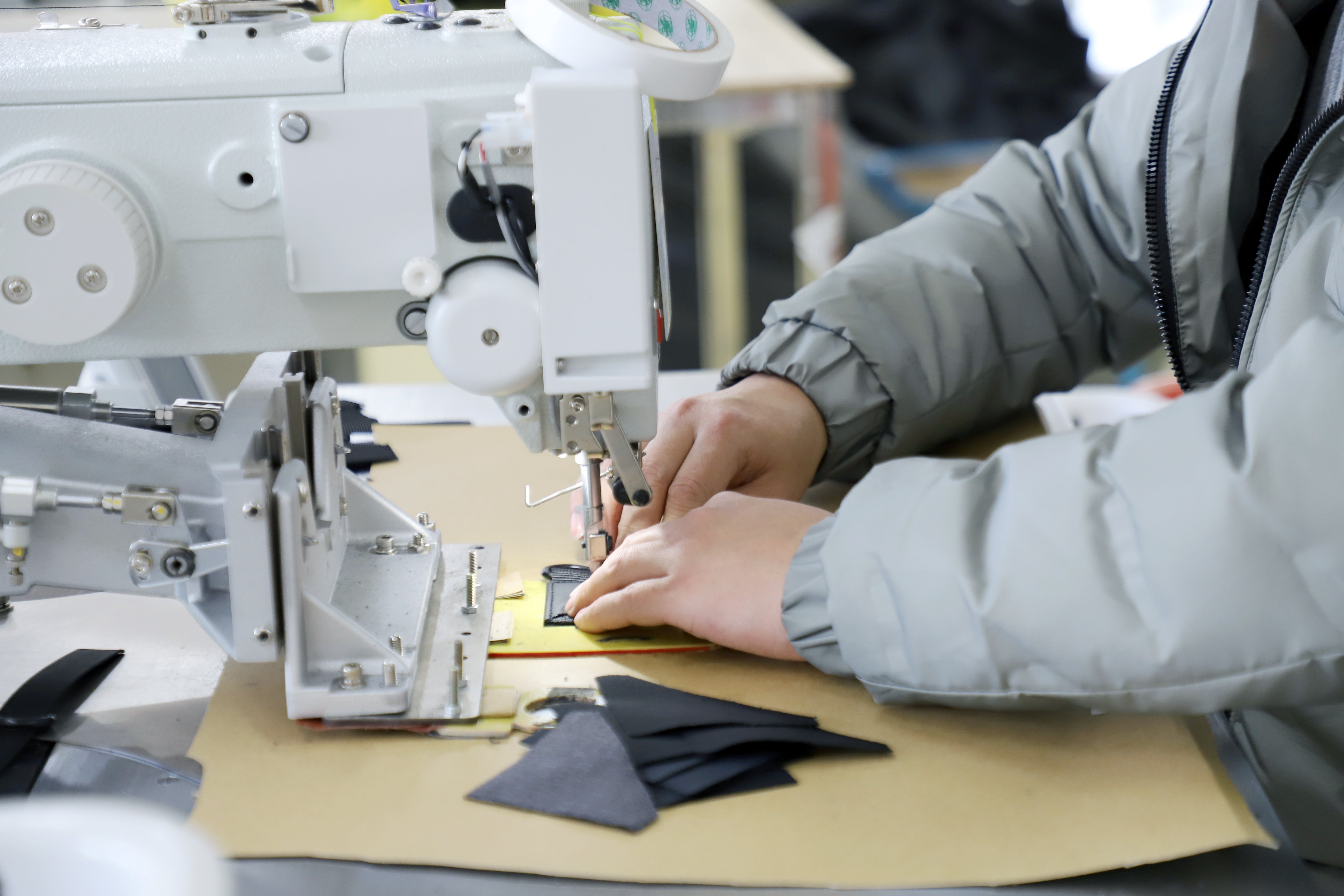
The three highest-risk seam locations in a laptop backpack are the strap attachment points, the base seam (where the bottom panel meets the main body), and the zipper attachment seam.
Strap attachment failures are catastrophic — a dropped bag sends the laptop and all contents to the ground. These seams must be specified at maximum stitch density (10–12 SPI), with box-X reinforcement and thread weight at T-70 minimum.
Base seam failures are gradual — the seam separates slowly from the bottom up as the bag is set down on hard surfaces repeatedly. Specifying a reinforcement tape over the base seam exterior, with the seam itself at 10 SPI, extends base seam life significantly.
Zipper attachment seams fail at the pull-end stops — the points where the zipper terminates and the tape is sewn into the bag. Specifying bartack reinforcement (a dense block stitch) at both ends of every zipper attachment prevents the most common zipper framing failure.
Count the stitches per inch on the pre-production sample using a ruler and magnifying glass. Focus on the strap attachment seams and base seam. This takes 5 minutes and requires no equipment beyond a ruler.
Request photographs of the strap attachment box-X stitching under 10x magnification from the factory's quality documentation. Stitch density deviations are immediately visible at this magnification level.
For production quantities, request that stitch density be included in the factory's in-process quality inspection records — a documented verification that stitch density meets specification on production line samples, not just on the pre-production prototype.
 Hot News


 EN
EN