
 EN



Seventeen years of laptop backpack production leaves a quality file that is mostly repetition. Four defects account for the overwhelming majority of our warranty conversations: zipper failure at the slider, shoulder straps pulling out of the shell, foam that compresses flat in one season, and stitch density that photographs well and fails under load. Each one forced a process change. Here is what we changed, what it cost, and what we still cannot promise.
Zipper Failure Was Rarely About the Zipper Tape
A German retailer came to us with 340 returns from a 12,000 unit run of 25L commuter backpacks. The complaint pattern was consistent: the main compartment zipper separated near the top of the curve. We tested 30 returned bags and found two causes, not one. The spiral element was a generic number 5 coil that had been opened and closed against an overstuffed bag, and the pattern itself put too tight a radius at the top of the opening, so the slider was always working at an angle.
At Tianqin we fixed the pattern before we fixed the component. The opening curve gained 15 mm of radius, the zipper tape channels were widened by 2 mm to stop the coil being pinched, and we moved the main compartment and laptop pocket to YKK number 5 and number 8 zippers. Then we added a 500-cycle open and close test on the finished bag, run on samples from every bulk run.
The cost was about USD 0.35 per unit on a 25L bag. That is real money at 10,000 pieces. We kept it, because the same retailer now specifies YKK in every purchase order it sends us, and returns on that style dropped to single digits per container.
Strap Pull-Out Changed Our Pattern, Not Our Stitching
Strap pull-out is a load path problem before it is a sewing problem. When a customer loads 12 kg of laptop, charger, and files, the force on the strap anchor is roughly four to five times the static weight during a normal walk, and far higher when the bag is swung by one strap onto a car seat.
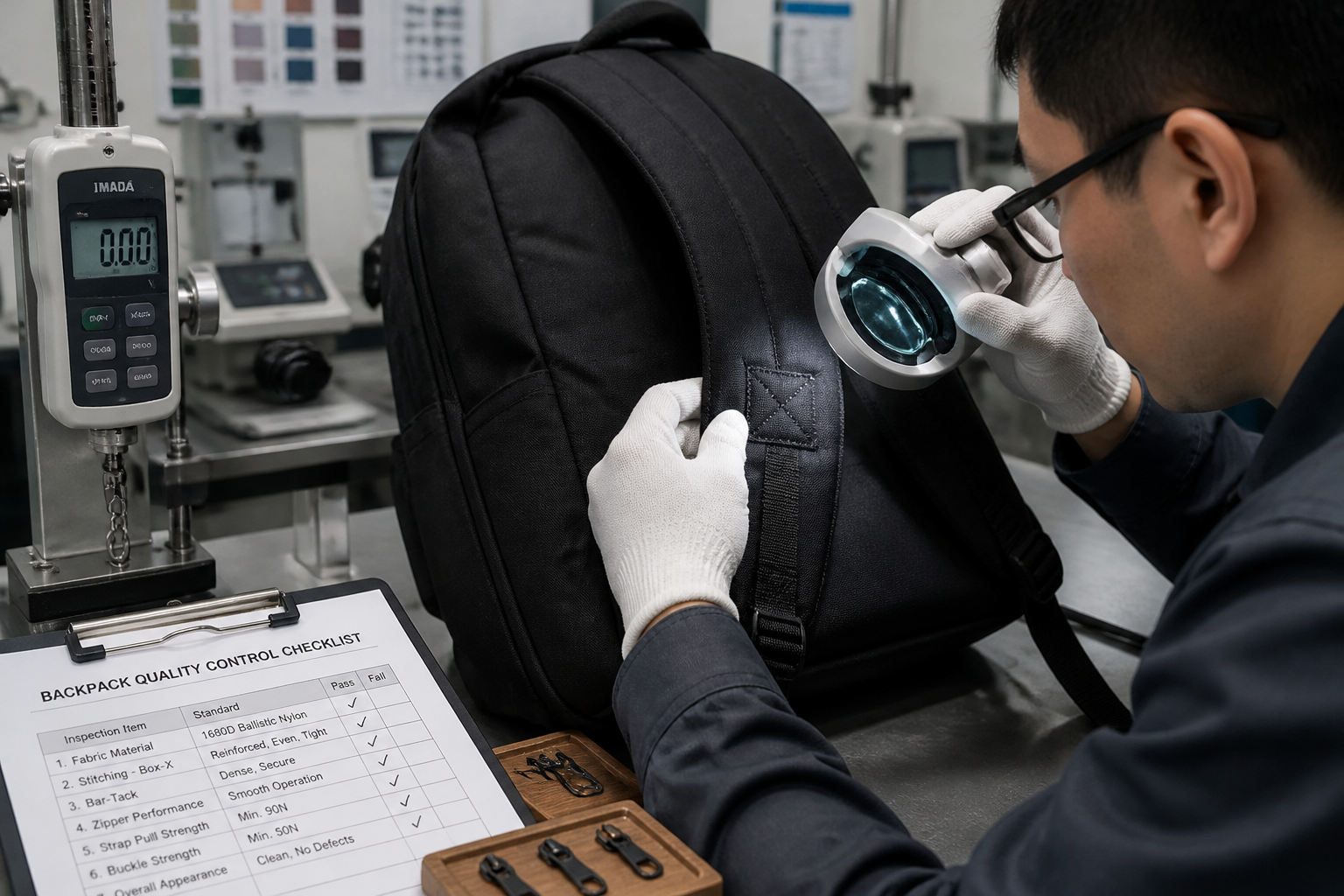
Our old anchor was a box-X stitch through the shell. It failed in the field at the bottom corners, and it failed in our own tests at around 18 kg of static load. The fix had three parts: a 40 mm bar tack at the anchor point, a reinforcement patch of 1680D ballistic nylon folded behind the shell, and webbing routed into the bag body rather than stitched flat on the outside. Static load capacity on the same style moved past 30 kg before deformation.
Handle and haul loop failures follow the same logic, which is why our top handle carries the same reinforcement treatment as the strap anchors and goes through the same 20 kg test.
We test this at 20 kg held for one hour on every bulk run, on bags pulled from the line rather than bags sewn specially for the test.
Foam Compression Appears in Month Four, Not Month One
Foam is where buyers save the most money and learn the most expensive lesson. Two foams with the same 10 mm thickness behave nothing alike. Low density PE foam at 18 kg per cubic metre loses roughly a third of its thickness after a season of daily use, which turns a laptop compartment into a loose pocket and drives complaints about screen pressure.
Our default at Tianqin now is 10 mm EPE at 25 kg per cubic metre with a false bottom 25 mm deep. We test recovery by loading a foam panel at 30 kg for 24 hours and measuring how much thickness returns after a one hour rest. If the sample loses more than 15 percent of its original thickness, we do not approve the foam for a laptop compartment.
There is a trade-off worth naming: heavier, denser foam pushes the bag over the 1.1 kg mark in a 25L build, and buyers who need a sub-900 g bag will have to accept a thinner compartment or a lighter shell.
Stitch Density Was the Cheapest Fix We Ever Made
Stitch density costs almost nothing and decides whether a seam holds. Our standard is 7 to 9 stitches per inch on main seams and 10 to 12 on strap anchors, top handle, and haul loops. The change from 5 to 8 stitches per inch across a 25L bag adds about 0.8 metres of thread, which is fractions of a cent.
There is an upper limit to that density. A dense stitch line in a loose weave can cut the fabric like a perforation line, so we test seam slippage alongside seam strength and we do not push beyond 12 stitches per inch on coated shell fabric.
Needle and thread selection matters just as much. We run bonded nylon thread on load-bearing seams and size the needle to the fabric so the coating is not perforated more than necessary. A larger needle than needed punctures a PU-backed coating and creates a leak path, which is one of the least understood causes of water ingress in a laptop backpack.
Thread consumption is easy to model and worth modelling before you argue about price. A 25L laptop backpack with six pockets and a padded sleeve swallows roughly 120 to 140 metres of thread across all seams, and bonded nylon costs more per metre than the polyester alternative. On a 1,000 piece run that gap is a few hundred US dollars, not thousands, which is why we do not negotiate it away.
Practical Tool: The Four-Point Defect Screen
Use this screen when you evaluate any laptop backpack factory, including ours. Each point has a pass or fail answer, and none of them require a lab.
Zipper: which brand and size on the main compartment and laptop pocket, and how many open and close cycles are tested on production bags
Zipper: is the opening curve radius fixed by the pattern, or adjusted by the operator at the machine
Strap: what static load is used, for how long, and are test bags pulled from production
Strap: is there a reinforcement patch behind the anchor, and how thick
Foam: type, thickness, density in kg per cubic metre, and false bottom depth in millimetres
Foam: how is compression recovery tested, and what is the fail threshold
Stitching: stitches per inch on main seams and on strap anchors
Stitching: thread type on load-bearing seams and needle sizing logic
Put These Numbers in Your Purchase Order
The most useful thing a buyer can do after reading this is to write the numbers into the specification, not the adjectives. Replace durable zipper with YKK number 5 on the main compartment and number 8 on the laptop pocket. Replace good padding with 10 mm EPE at 25 kg per cubic metre and a 25 mm false bottom. Replace strong straps with a 20 kg one hour static load test on two bags per 500 units.
Honesty about the limits matters as much. We run sampling inspection, not 100 percent inspection, so we cannot promise zero defects. Our internal claim rate across laptop backpack programmes sits around 0.6 percent of units, and roughly two thirds of those claims are zipper related. A buyer asking for zero defects is buying a contract clause, not a process. The first question most buyers ask us is what we do when defects are already in the container, and the answer is a documented claim procedure with photos, batch codes, and a replacement or credit decision inside 10 working days.
Send us the four numbers you want guaranteed, and we will return a specification review plus a sampling plan. Our sample turnaround is 7 to 15 business days, and every quotation can include SGS test reports on request. Email [email protected] or visit www.tianqinbag.com to start an OEM or ODM laptop backpack project.

 Hot News


