EN



A brand owner sets aside 800 USD for development, on the reasonable assumption that a factory already owns the patterns. The first tooling list comes back at 2,410 USD. Half of that number is paid once and half is still being paid three years later, and nobody on the quote explained which was which. That distinction decides whether your product development budget is a one-off or a permanent line in the P and L.
The Development Stack, Item by Item
These are the items that actually appear on our tooling invoices for a 25 litre laptop backpack with a padded sleeve, organiser panel and trolley sleeve.
3D rendering and virtual sample: no charge for the first one, because it is faster for us than arguing about a sketch
Pattern making and size grading: 160 to 350 USD per style, depending on how many sizes
Marker and cut file for the automated cutter: 60 to 120 USD
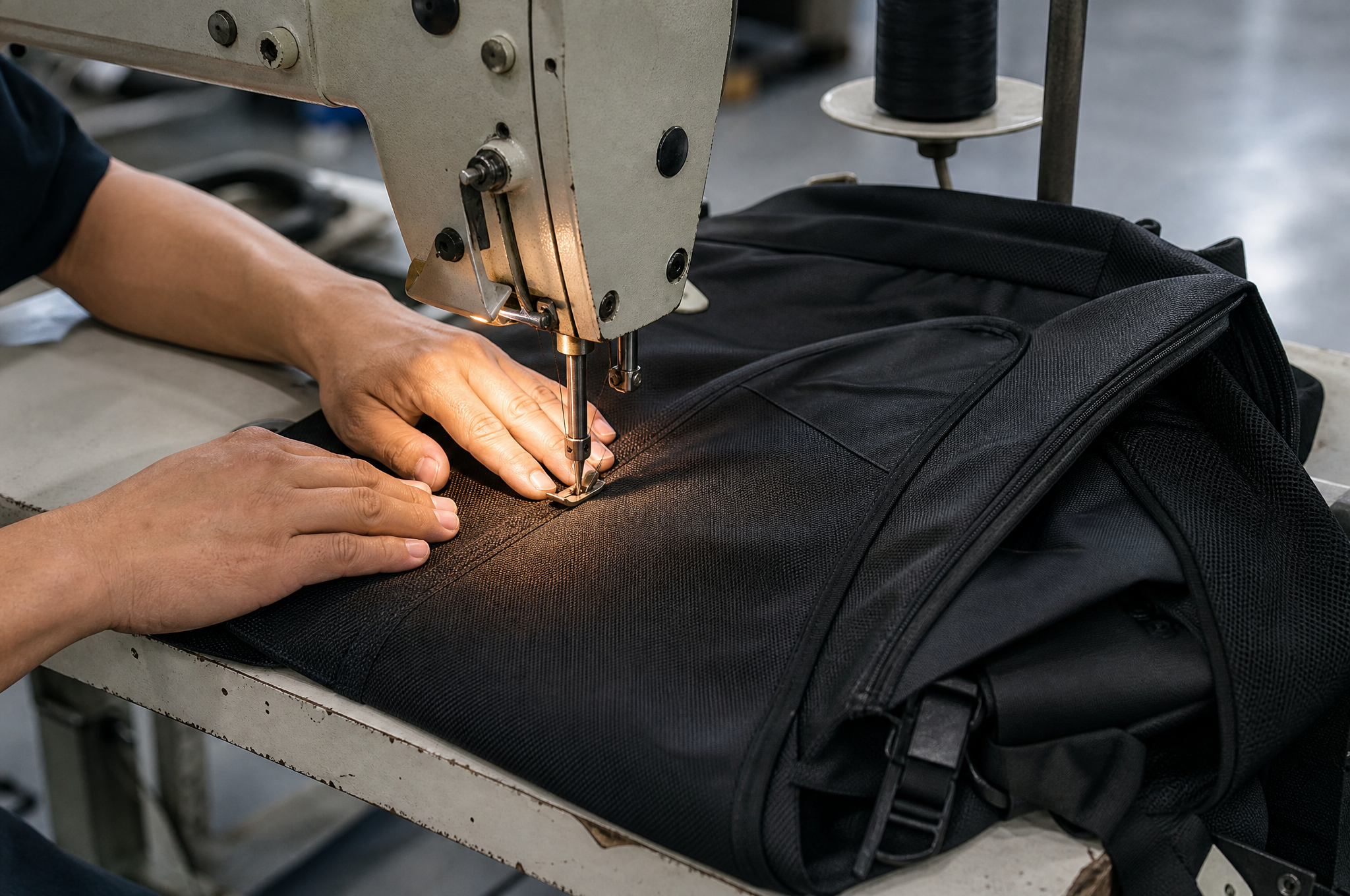
First prototype: 120 to 260 USD, including material and two hours of sample room time
Second round after fit comments: 90 to 180 USD
Salesman sample and photo sample: 80 to 150 USD each
Clicking dies for foam panels, stiffeners and the laptop sleeve: 55 to 120 USD per die, usually three to five dies per style
Silicone emboss logo mold: 90 to 180 USD
TPU patch mold: 250 to 500 USD
Etched metal plate for a badge: 70 to 150 USD
Heat transfer plate or screen: 40 to 90 USD per colour
Embroidery tape plus digitising: 25 to 60 USD per logo, with 30 USD of digitising once
Hangtag and carton print plates: 45 to 120 USD
Test reports on a new material: 300 to 600 USD through an accredited lab
Not every program touches every line. A private label order that uses our existing 25 litre block and applies a logo may only pay for the logo plate and the print plates, which is under 300 USD.
The question most buyers ask us here is why the list cannot simply be absorbed into the unit price. It can, given enough units, which is the third model further down.
Which Costs Come Back and Which Do Not
One-time costs are the pattern, the marker, the structural dies and the first mold. Once paid, they support every future order of that style. That is the entire economic argument for a development budget.
Recurring costs are the ones buyers misclassify. Test reports are not one-time: a new material, a new colour with a different dye class, or a regulation change all require a fresh report. A logo mold is not one-time either, because silicone molds wear at the fine edge and a 3 mm raised logo becomes a 2.4 mm logo after heavy use.
Semi-recurring costs sit in between. A new colourway needs new lab dips and a bulk approval, and if the colour lands on a printed element it needs a new plate. A carton change from 8 pieces to 10 pieces needs a new print plate. These arrive with each season, not with each style, and they are the reason development budgets overshoot.
We track this per program. Every die we hold for a buyer is logged with its make date, its strike count and its last inspection, so when a reorder arrives we can say whether the die is serviceable or needs remaking before we quote.
Buyers also ask why a mold cannot simply be reused for a second logo. It can, when the second logo has the same artwork at the same size and the same relief height. It cannot when the artwork moves by a millimetre, because the silicone is cast from a machined master and the master is what the money actually paid for. This is why an artwork change in month two is cheap and an artwork change in month twenty is not.
Why the Dies Do Not Travel
Die sets are style-specific, and buyers consistently underestimate how specific. A die set cut for a 25 litre body does not fit a 27 litre body, because the foam panel curvature and the sleeve depth change. Even a 2 cm change in the laptop compartment height can make the existing foam die unusable.
Dies also wear out. A foam die with a 3 mm blade runs roughly 40,000 to 60,000 strikes before it needs resharpening, and resharpening changes the panel dimension slightly. On a program that runs 5,000 units a year, that is not a problem for four or five years.
Here is the limitation worth stating plainly. If you move a program to another supplier, the physical dies can move with it, but the new factory's cutting bed and press may not accept them, and the pattern tolerance they work to will differ. In practice most buyers pay for the tooling twice when they switch, and that cost belongs in your supplier-switching calculation, not in a surprise.
Storage is on us for 24 months after the last order. Beyond that we ask before scrapping anything, and we have held molds for four years when a buyer asked.
Amortise, Charge Up Front, or Refund
There are three workable models, and the right one depends on the size of the first order.
Charging up front is cleanest. The buyer pays the tooling, owns it, and the unit price contains no hidden recovery. We invoice tooling separately and the unit price stays stable for the life of the style.
Amortising into the unit price is what most small brands prefer, because it protects cash flow. The risk is that it makes the unit price less comparable with other quotes, since it hides a recovery line inside material or labor.
Refunding against volume is a reasonable middle. Our standing policy is that logo molds are waived above 1,000 units, pattern and marker costs are not charged on a style we already run, and structural dies are charged at cost and refunded once cumulative volume reaches 3,000 units.
Watch the arithmetic on refunds before you pick a model. If a 240 USD die set is refunded at 3,000 units, the recovery is 0.08 per unit and nobody notices it. If the same 240 USD is amortised across 300 units instead, it is 0.80 per unit and it changes the margin conversation at retail. Tooling cost relative to order size is what should decide the model, not habit.
Whichever model you use, put it in the purchase order. Ownership of the tooling, the volume threshold for refund, and the storage period should be written down, because the conversation is much harder after the third reorder.
A Tooling Budget You Can Actually Use
Work down this list with your supplier and ask for a number against every line that applies.
Pattern and grading, quoted per style and per size
Dies listed individually, with a remake cost for each
Logo tooling by method, since methods differ by a factor of five
Print plates for hangtag, polybag and carton
Sample rounds expected, including courier
Test reports required by your market, and their validity period
Refund or waive conditions, stated as a volume figure
Storage period and the notice you get before disposal
The most common omission on that list is the remake cost of a die. Ask for it at the same time as the original price, because it is the number you will need in year three when a panel no longer measures true and a reorder needs a decision inside a week.
Send the Artwork and the Style Reference
Send us your logo files, your target retail price and a reference style. We will come back with the tooling list line by line, marked as one-time or recurring, and a unit price that shows exactly where the recovery sits.
Quanzhou Tianqin Bags Co., Ltd has 17 years of bag manufacturing experience, a 3D sampling capability that resolves most shape questions before a die is cut, and OEM and ODM programs running for buyers in more than 50 countries. Sampling takes 7-15 working days, and we do not cut a die until the 3D and the fit sample are both signed off.
Email [email protected] or visit www.tianqinbag.com with your artwork and reference style. Ask for the tooling list with the one-time and recurring columns separated, and the budget conversation becomes a two minute discussion instead of a two week one.

 Hot News