
 EN



A factory is not a tap you open when you need 20,000 units. It is a fixed set of lines, operators, and cutting hours, already committed to other buyers. When a new laptop backpack program arrives, the real question is which line, in which month, at what interruption to work already sold. Here is how we slot an order at Tianqin, and the questions that tell you whether a supplier's monthly capacity number is real.
How we count monthly capacity
Capacity is construction-dependent, not a single factory figure. We publish a range rather than one number because the same floor produces different output for different products.
At Tianqin, our Quanzhou facility runs multiple sewing lines for bag programs. A line of 35 to 45 operators produces roughly 600 to 900 laptop backpacks per day on a standard single-compartment construction with a padded sleeve. A 30L multi-compartment backpack with a trolley sleeve, organizer panel, and USB port can drop line output by 25 to 35 percent, because assembly minutes per unit rise while line staffing stays flat.
A monthly output claim of 60,000 units therefore means something different for a 20L pack than for a 30L travel-oriented pack. Buyers should always ask for output per construction, per line, per day, then multiply.
Cutting capacity is usually not the constraint. Automated cutting runs 800 to 1,200 units per shift on a mid-size backpack, so one cutting line supports several sewing lines.
Machine hours are the second constraint, and buyers rarely ask about them. Bar-tack machines, long-arm machines for front panels, and the hanging conveyor all have finite hours. A construction that needs heavy bar-tack work at the strap junction can be limited by machine time even when operator time is available, and that shows up as a longer calendar rather than a higher price.
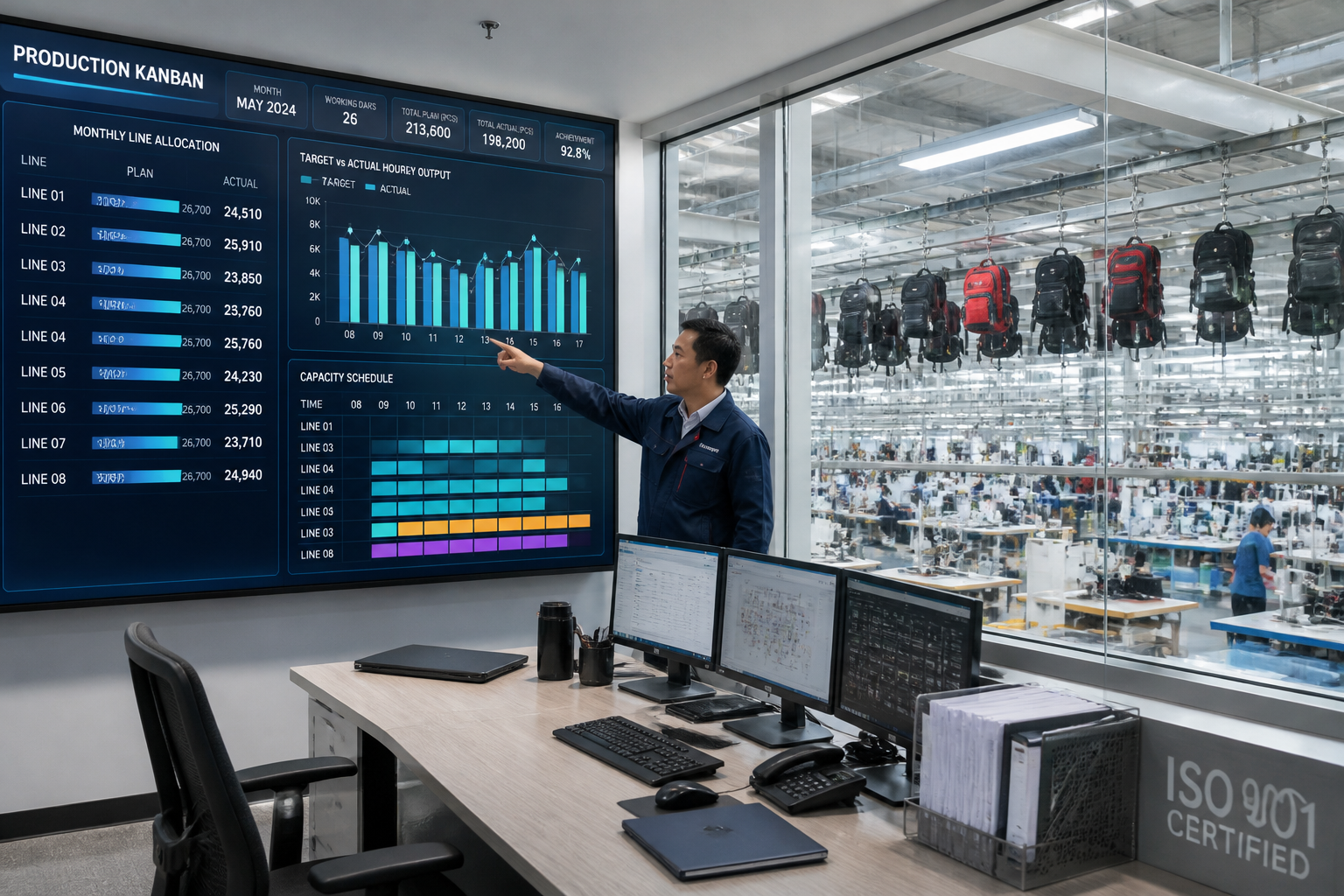
Line allocation: how a new order lands on the floor
When an order is confirmed, the planning team assigns it to a line by construction similarity, not by order date. This is the part buyers rarely see, and it decides their lead time.
Our allocation logic, in order:
Construction family. A laptop backpack goes to a line already fluent in padded panels and zipper work. Moving it to a line that normally runs tote bags costs 2 to 4 days of learning curve.
Material family. Ballistic nylon and Oxford polyester cut and sew differently. Keeping similar fabrics on one line reduces needle and machine changes.
Order size against minimum viable line run. We will not break a line for 300 units if a 3,000-unit order is queued behind it, unless the buyer accepts a longer calendar.
Packaging complexity. Retail hangtags, polybags, and carton configuration can add a day of packing time per 1,000 units.
This is where an honest limitation sits. Small orders do not get small lead times. A 300-unit run occupies a line setup worth several thousand units of efficient work, and we schedule it in a gap rather than in prime season.
There is also a learning curve buyers should price into a switch. A line that has never run a laptop backpack with a padded, suspended sleeve needs roughly 3,000 units before output reaches the steady-state rate. When a program moves from one supplier to another, the first month typically runs 10 to 15 percent below the quoted monthly figure. Suppliers who quote flat output from day one are usually quoting the steady-state number.
Peak season queueing: July to October
The bag industry's peak is not December. It is July through October, when US and EU retailers place orders for spring and holiday resets.
During that window, our booking calendar fills 4 to 8 weeks ahead. Two consequences follow. A confirmed order in late August may sit 10 to 14 days before a line slot opens, and no amount of urgency moves it, because the lines ahead are already running sold work. Accepting a peak-season rush order also means either paying an overtime premium or displacing another buyer's scheduled run, and we do the first only.
Chinese New Year adds a hard break of 10 to 21 days of factory closure plus a 2 to 3 week ramp as operators return. Orders that land in January without a January slot move to late February.
Booking behavior gives buyers a lever. Buyers who reserve a slot in April or May for a September ship date get the peak month they want, and their unit price carries no overtime premium. Buyers who arrive in August get a later slot, a premium, or both. The calendar does not negotiate, but it does reward whoever books first.
How we slot a new program
At Tianqin we ask for four numbers before quoting a monthly output figure: target units per month, construction complexity, packaging specification, and required delivery window.
Then we produce a plan with a slot date, not a vague promise. On a recent EU private-label program for a 25L business laptop backpack, the buyer needed 8,000 units per month for four months. We assigned two lines on the same construction family, committed 4,000 units per line per month with a two-week ramp, and reserved a third line for the buyer's reorder in month three. We declined a fourth month in peak season at the requested date and offered a 12-day slip instead. The buyer accepted, because they could see the calendar rather than a promise.
The first question most buyers ask us is whether their order will be treated as a priority. The honest answer is that priority is a scheduling term, and we will tell you your slot date and your displacement risk rather than promise a queue position we cannot hold.
We also ask about the reorder pattern, because it changes the allocation we can offer. A buyer planning 8,000 units per month for four months needs a different arrangement than a buyer planning 30,000 units once. Repeat volume is easier to plan for, and we will hold a line reservation for a program we can see continuing past the first order. A one-off order in peak season gets the best slot we have left, which may not be the slot the buyer wants.
Questions to ask before you accept a capacity number
Ask these in writing, and expect specific answers. Vague responses are the warning sign.
How many lines can run my construction, and how many operators per line?
What is daily output per line for my exact construction, not a category average?
What is your current booking window, in units and in weeks?
Which month is my slot, and what is the reserved start date?
What percentage of capacity is already committed for my slot month?
What happens to my lead time if my order quantity increases by 50 percent after deposit?
How do you handle the Chinese New Year window and the return ramp?
What is your overtime policy, and is it included in the quoted lead time or charged separately?
Can you show a capacity plan for the previous two months against actual output?
Which other buyers share the line capacity you are offering me?
For a first order, request a trial of 500 to 1,000 units on the assigned line. It verifies the output claim with your construction before you commit season volume.
Reserve the slot before you need it
Capacity is the earliest constraint in a seasonal program, and it is sold before most buyers start negotiating price. Confirm your construction, ask for a slot date, and reserve it with a deposit while the calendar still has room.
Send your monthly volume target and construction summary to [email protected], or review our OEM and ODM programs at www.tianqinbag.com. Sampling runs in 7-15 business days, and we will confirm a monthly output figure for your specific laptop backpack construction in writing.
 Hot News


