
 EN



Most supplier tours show the same three minutes: a cutting table, a sewing line, and a stack of finished cartons. What a tour rarely shows is where work waits, and waiting is what sets your ship date. Here is how a laptop backpack order actually moves through our Quanzhou plant, where automation earns its cost, and the inspection points where a person still outperforms a machine.
Order release and material staging
Bulk starts with a release meeting, not a cutting schedule. The approved sample, the tech pack revision, the bill of materials, and the packing specification are checked against each other. Any mismatch stops the release.
At Tianqin, release includes an in-house material verification: shell fabric roll count and denier, zipper length and brand check, foam density measurement, and hardware weight sampling. We do this because the most expensive defect is a mis-specified component discovered at unit 800.
Staging then moves material to the line in kits. A kit for one laptop backpack contains the cut panels, lining pieces, foam, webbing, zippers, and hardware for that unit, pre-sorted. Kitting is unglamorous, and it removes 15 to 20 percent of the operator search time that otherwise shows up as invisible delay on a manual line.
Release also fixes the inspection plan. We agree the in-line check point, the AQL level, and whether the buyer's third-party inspector attends the run or only the final shipment. Settling this at release avoids a clash later, when an inspector's calendar may not match the day the run finishes. On one order the inspector could only come on day 14 of a 20-day run, so we held back 60 percent of output for a pre-shipment check instead of counting the in-line visit twice.
Automated cutting in practice
Cutting is the most automated stage in a modern bag factory and the easiest to measure.
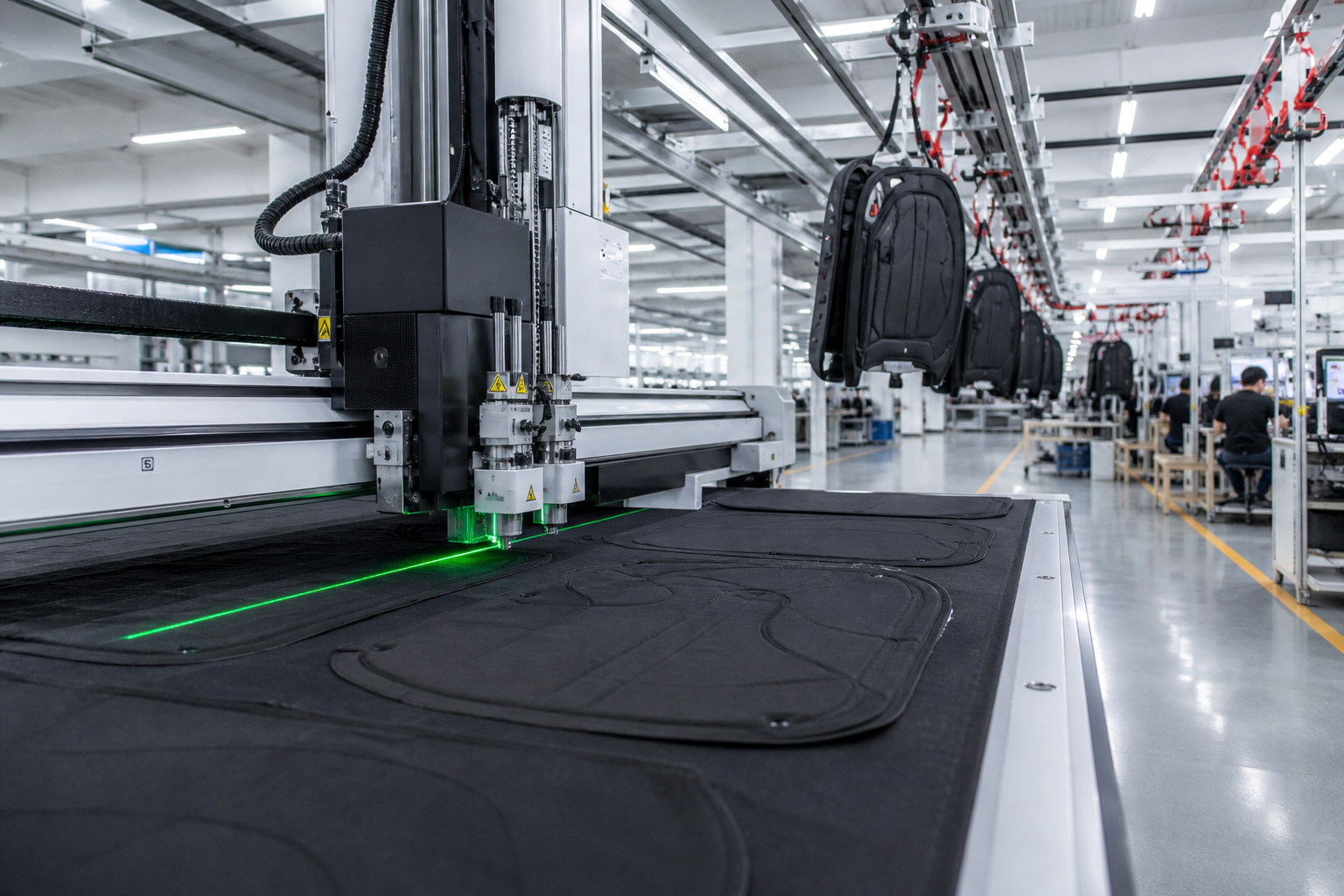
Our CNC cutting line takes a nesting file generated from pattern data and cuts a full marker in one pass. On a mid-size laptop backpack with roughly 60 to 90 pattern pieces, the automated line runs 800 to 1,200 units per shift, with dimensional tolerance around plus or minus 1 mm on straight and gently curved edges.
Two gains matter to buyers:
Fabric utilization. A well-nested marker on the automated line holds waste near 1 to 3 percent, against 5 to 8 percent typical on manual cutting of the same pattern.
Consistency. Every panel in a 2,000-unit run matches within tolerance, so the sewing line does not fight variation at the join.
Two honest constraints. Automated cutting handles complex curves better than hand cutting, but it wastes fabric on very small nested pieces. Coated 1680D ballistic nylon requires a sharper blade change cycle than 600D Oxford, which we schedule every 300 to 400 markers. And for a 200-unit trial run, manual cutting is often faster than the setup time for the nest.
We also use cutting data as a quality record. Because the nesting file carries batch, size, and roll information, a panel can be traced back to the roll and the marker it came from. When a color deviation appears in a finished unit, that trace takes minutes instead of days, and it tells us whether the problem is one roll or the whole lot.
The hanging conveyor and work-in-progress control
The hanging conveyor is the quietest technology in the plant and the one that changes lead time most.
Individual backpack bodies hang from numbered hooks and move automatically between assembly stations, each station calling the next unit it needs. Because the system tracks units in process, we know the status of a run at any hour rather than at the end of a shift.
What that changes operationally:
Work in progress stays lower than on a bundle-and-push system, because a station pulls only what it can process.
Defects are caught earlier. A misaligned zipper on hook 40 is visible while the operator still remembers the unit, instead of surfacing at packing.
Mixed-model runs become practical. A buyer can split an order across two sizes or two colourways without splitting the run into two calendar blocks.
On a 2,000-unit order, the conveyor system typically compresses final assembly by 2 to 4 days against a manual push line with the same staffing.
The conveyor also gives us real numbers for capacity planning. Daily output per line comes from hook throughput rather than an operator count, which is why we can quote output per construction instead of a category average. A buyer asking how many laptop backpacks a line makes per day should expect an answer that references the tracking system, not an estimate.
Semi-automated assembly: machines plus hands
Assembly is where automation stops being the main story. Zipper insertion on a curved panel, webbing bar-tacking at a strap junction, and hardware riveting still need human judgment for alignment and tension.
Our approach is semi-automated. Machines perform the regulated operations, such as programmable bar-tack patterns and heated zipper setting, and operators perform placement and quality decisions. On a 25L business laptop backpack, roughly 65 to 75 percent of assembly minutes are operator time.
That ratio is a trade-off, not a failure. Fully automating curved zipper insertion on soft goods costs more in tooling than it saves in labor at our order sizes, and it reduces flexibility to change pocket layouts between buyers. A buyer asking for a new pocket geometry should expect that change to remain a manual operation on the first run.
The first question most buyers ask us is how much of the line is automated. The answer is that cutting is nearly fully automated and assembly is mostly not, and a supplier who claims otherwise has probably not measured operator minutes per unit.
New programs spend their first days under closer supervision. Our line leaders keep a first-article check on the first 20 units and a second check at 200. A construction that drifts outside tolerance pauses the line for a re-briefing rather than continuing and sorting defects later, because sorting finished units costs more than stopping the line for an hour.
Where human inspection beats machines
Use this list as your own audit guide when you visit any bag factory.
Seam puckering and tension on coated nylon: a hand runs along the seam, because cameras read texture as noise.
Strap junction strength: a pull test at the bar-tack reveals a skipped stitch that a visual scan misses.
Zipper glide around corners: an operator feels drag and catch that appears smooth on video.
Laptop sleeve depth: measure it at the seam, not at the pattern, since stretch and seam take-up can reduce usable depth by up to 10 mm.
Hardware feel: puller weight, snap spring tension, and rivet seating are tactile checks.
Colour matching across panels from different fabric rolls: human eyes catch metamerism that sensors rate as pass.
Weight check: a finished 20L pack should sit inside a stated band, and we verify per unit, not per carton.
Automated inspection earns its place at the cut layer and in measurement. It does not replace a trained hand at the assembly join.
Match the automation to the stage that limits you
Automation pays where volume is predictable and the geometry repeats. Ask any supplier which stage in their plant is the constraint, and whether their automation addresses that stage or a different one. A machine that speeds up an unconstrained stage does not shorten your ship date.
A useful test in any factory: ask what percentage of your order will be cut by machine, how many units that machine handles per shift, and how many assembly minutes remain manual. Suppliers with a real system answer in numbers within a minute. Suppliers without one describe equipment brands instead.
Send your construction and target volume to [email protected], or see our factory capability at www.tianqinbag.com. Sampling runs in 7-15 business days, and we will tell you which stages of your specific laptop backpack will run automated and which will stay manual.

 Hot News


