
 EN



A buyer in Frankfurt sends a photo of a returned bag: the checkpoint hinge has torn through the lining on one side after eleven trips. The design opened flat on the sample table, so it passed inspection. It failed the second the traveller lifted the bag by one panel while it was lying open on the tray.
That is the gap between a bag that looks checkpoint-friendly and one that survives a year of security lanes.
What "TSA-friendly" actually describes
There is no certification behind the phrase. No US authority issues a TSA-friendly certificate, and no test standard defines it. What the term describes is a construction behaviour: the laptop compartment opens flat, the machine can lie in the tray without being removed from the bag, and the officer can see the device without handling it.
That matters for a buyer because you are buying a behaviour, not a compliance document. If a supplier tells you a bag is "TSA approved", ask which body approved it. The answer will be nobody. What you can specify is the geometry that produces the behaviour, and that is where the conversation should go.
What buyers actually want from the category is a bag that reduces the chance of a secondary screening, because a bag that goes through the scanner cleanly is a bag that does not get opened by hand. The feature earns its retail price in that moment, not on the spec sheet.
Two real requirements come from the traveller side. First, the flat-open panel has to clear the laptop screen, roughly 200mm of clearance at the top edge on a 15-inch machine. Second, the opening has to be visible from standing height, which means the zip runs around three sides rather than two.
Flat-open construction in the pattern room
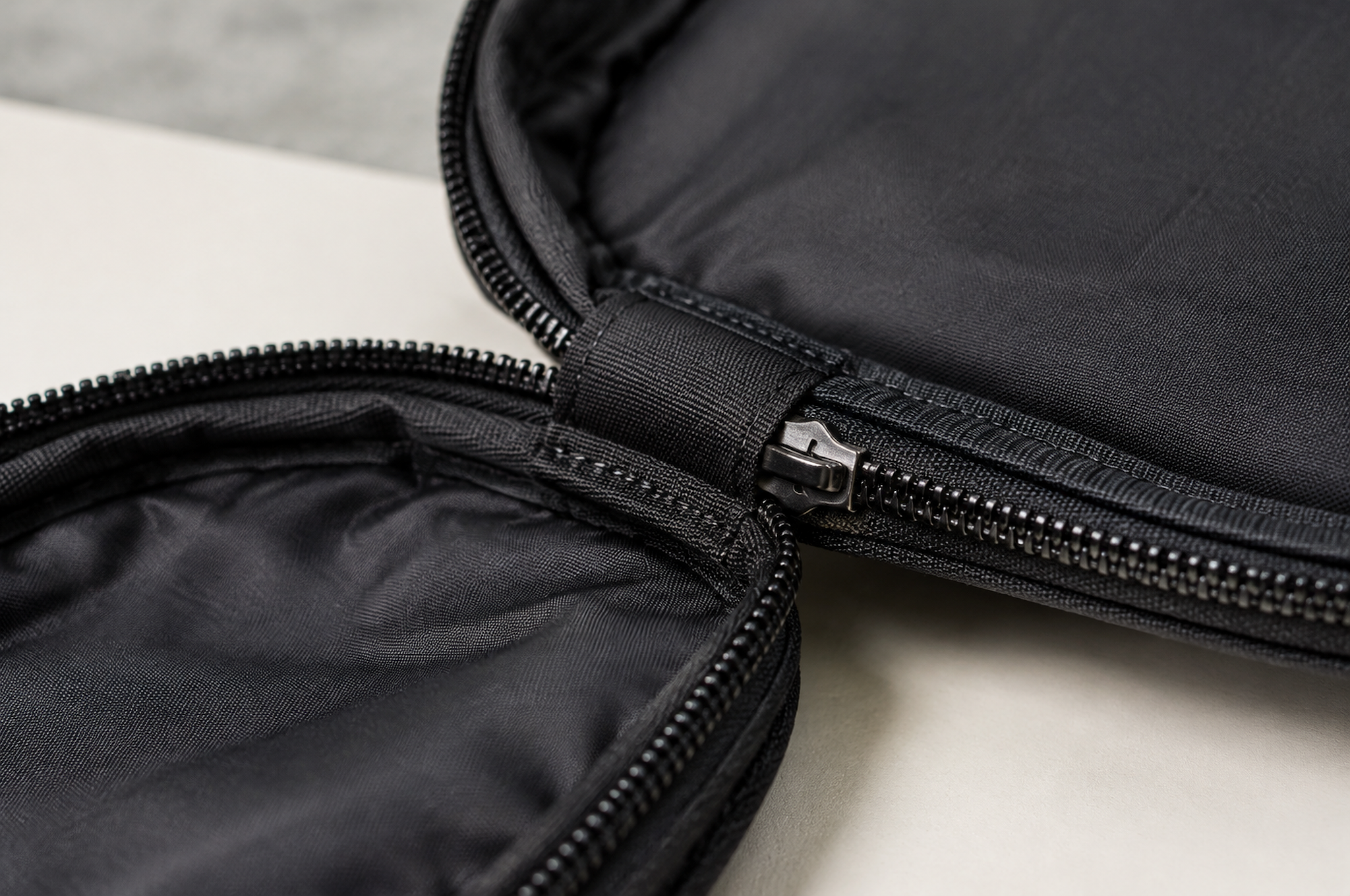
A true flat-open compartment is built as a separate hinged panel, not as a zip sewn into the main body.
Our standard layout for a checkpoint bag uses a 10 gauge coil zipper running down the left side, across the bottom of the panel and up the right side, stopping 40mm short of the top. The result is a panel that folds down to roughly 180 degrees. The pattern has to add 8mm of ease along the hinge line, because a panel cut to the same length as the opening will bind when it folds.
The second decision is where the laptop sleeve sits. If the sleeve is attached to the folding panel, the machine moves with the panel and the officer can read the screen. If the sleeve is attached to the bag body, the laptop stays put and only the panel folds away. The second version is easier to sew and 0.4 USD cheaper, and it is what most sub-20 USD factory-gate bags use. It also means the laptop can slide out when the panel is open, which is exactly what the checkpoint design was meant to prevent.
We now quote both versions with the difference stated, so the buyer chooses rather than discovering it in a review.
Hinge hardware and the durability question
Most checkpoint backpacks do not use metal hinges. They use a fabric hinge: the two panels joined by a strip of 1680D or 600D with a bar-tack at each end. The metal or plastic hardware, when it exists at all, is a stiffener at the fold, not a pivot.
The failure mode is consistent. The bag is open on the tray, the traveller grabs one corner to lift it, and the entire open panel becomes a lever. A 1.5kg bag with a 2.2kg laptop in an open configuration puts a peel load on the hinge strip that the stitch line was never designed for.
Three construction changes reduce this materially:
Run a 25mm webbing tape under the hinge strip from one side panel to the other, so the load bypasses the stitching and goes into the shell.
Bar-tack the hinge ends with a 42-stitch tack rather than a 28-stitch tack. It costs seconds, not money.
Limit the fold to 170 degrees rather than a full 180. A full fold puts the hinge under tension every time the bag is set down open.
At Tianqin we ran a 500-cycle open-and-lift test on three hinge constructions before we standardized. The unwoven version failed at a mean of 180 cycles, the woven version at 410, and the version with the webbing bypass passed 500 with the hinge still square. That test is now part of our standard sample report for any checkpoint program.
There is a cost consequence buyers do not expect. The webbing bypass has to be sewn before the back panel is closed, which means it cannot be added to an existing pattern without a revision. We have had two clients ask for it as an inline change to a running order, and both times the answer was a new pattern plus a 5-day schedule slip. If you think you may want the bypass, spec it in the first sample.
Checkpoint behaviour buyers should test
Do not approve a checkpoint sample by looking at it. Book two seats, or at least use a 15-inch dummy load and a table.
Open the bag with one hand while it is on a flat surface. If it needs two hands, the traveller will not use the feature.
Lift the open bag by one corner with 3kg inside. Watch the hinge strip, not the fabric.
Zip the panel closed with the bag full. A flat-open zip that only runs smoothly on an empty bag will jam at the airport.
Check that the laptop cannot slide out of the sleeve with the panel fully open and the bag tipped 30 degrees.
Measure the packed depth. A hinged panel adds 12 to 18mm to the depth when closed, which can push the bag out of an underseat fit.
The limitation worth stating plainly: a flat-open compartment costs you main-compartment volume. The hinge panel and its stiffener take up 1.5 to 2 litres of usable space in a 25 litre bag, and there is no way to recover that without reducing the laptop sleeve size. Buyers who need both a 20 litre main body and a checkpoint panel usually end up at 28 litres overall, which then fails the underseat check. You cannot have all three.
A specification list for your next PO
Put these lines into the tech pack before sampling, not after:
Zipper size and type on the checkpoint opening, with brand named
Hinge construction, including whether a webbing bypass is required
Sleeve attachment: panel-mounted or body-mounted
Fold angle limit and the stiffener material
Clearance at the top edge for a screen of the target laptop size
Closed depth increase over a non-checkpoint version of the same bag
Test method for hinge durability and the pass threshold
The first question most buyers ask us about this category is whether the checkpoint feature raises the unit price. At 1,000 pieces the answer is about 0.65 USD to 0.95 USD at FOB level, mostly zipper length, the extra panel and the stiffener. That is small against a retail price of 79 USD, and it is the cheapest way to differentiate in a crowded travel assortment.
Specify the behaviour, then test it
Send your target laptop size, your channel and your price band to [email protected], and we will send a checkpoint construction proposal with the hinge test data attached. Sample turnaround is 7-15 working days, and we include the open-and-lift cycle result in the sample report so your QA team has something to compare against. Full OEM and ODM capability, plus SGS reports on request, is listed at www.tianqinbag.com. Quanzhou Tianqin Bags Co., Ltd has been building bags for 17 years and exports to more than 50 countries.

 Hot News


