
 EN



A complaint arrives on a Tuesday morning: 40 bags from the March shipment have a zipper that will not close. The retailer wants credit by Friday. You have a photograph of a slider at an angle that shows nothing, no carton numbers, and no idea whether those 40 bags came from one production day or six. This is not a service problem. It is an evidence problem, and it was decided weeks before the complaint.
Claim Evidence You Should Ask For On Day One
The evidence set determines whether a complaint can be resolved in 48 hours or drags for three weeks. Ask for six items, and put them in the supply agreement so the request is not a negotiation each time.
Photograph of the failure, close enough to see the component, with the defect visible rather than described
Photograph of the bag label showing the production code or PO reference
Carton label photograph, which links the unit to a production date and a line
Quantity affected and quantity in the customer's total stock, so the rate can be calculated
Date of sale or date of receipt, which separates a shipping failure from a use failure
A statement of what the customer wants: credit, replacement, or repair
Buyers often push back on the carton label item, since the carton may be gone. That is a legitimate constraint in retail, where cartons are broken at the store and discarded within days. Our compromise is simple: the bag's internal label carries the same production code as the carton, so a photograph of the internal label gives us traceability without the carton.
Response Windows Buyers Should Commit To
Silence costs more than a bad answer. Set clock times and publish them.
Acknowledge within 1 working day, with a case number and the name of the person handling it
Request missing evidence within 2 working days, in one message rather than four
Give a preliminary assessment within 5 working days
Resolve within 15 working days for straightforward cases, 30 for cases needing a third-party inspection
On our side, we commit to a factory response within 3 working days of receiving a complete evidence pack, and we say plainly when we cannot assess a claim because the evidence is incomplete. That last sentence is uncomfortable in a sales meeting and useful afterwards. A supplier who always says yes in the first email is usually accumulating a bigger problem.
The clock should pause while evidence is missing. If it does not, the brand carries the delay for a document the customer never sent. Write the pause into the agreement.
Credit, Replacement, Or Repair
Three remedies, three cost profiles, and one rule: match the remedy to the failure type rather than to the customer's mood.
Credit is right when the defect is real, the quantity is clear, and the unit will not be recovered. It is fast and clean. It is wrong when the same defect will recur in the customer's remaining stock, because credit on 40 units leaves 600 units that will fail the same way.
Replacement is right for structural failures and for anything where the customer cannot use the product at all. Replace the affected units, and take the failed units back for teardown, because a teardown is the only way to know whether you are looking at 40 units or 4,000.
Repair is right for wear items and single components. A slider swap at a local repair shop costs the brand a few dollars against a full unit replacement.
Our working split on laptop backpack programs: single component failures under 1 percent of the affected lot, repair or parts. Above 1.5 percent with the same failure mode, we ask for returned samples and treat it as a production issue rather than a service issue, which changes who pays.
The question that decides the case
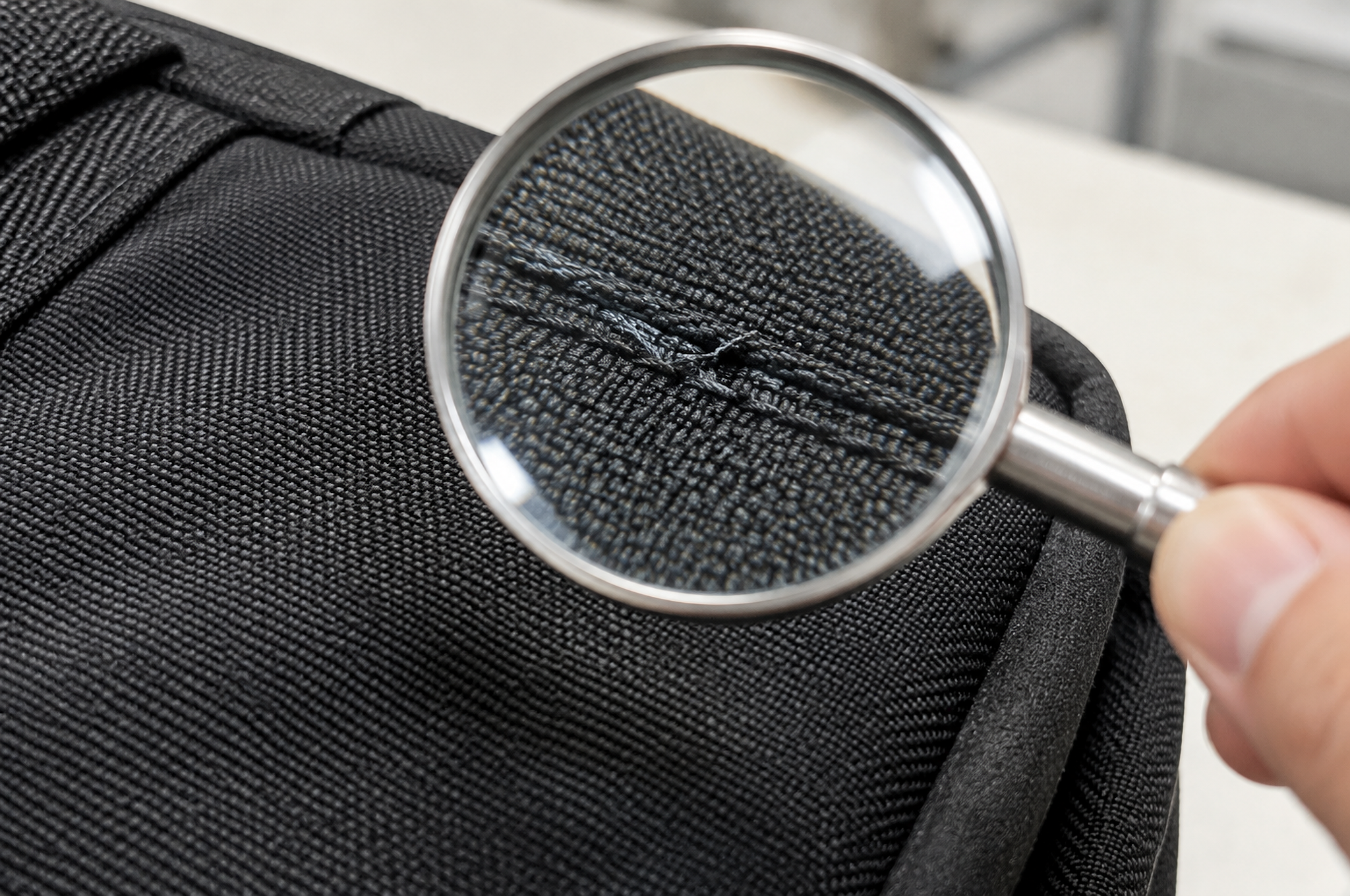
The first question most buyers ask us is whether the failure is a defect or a use case. It is the right question, and it is answerable more often than people expect. A strap anchor that separates at the bar-tack shows a stitch pattern in the tear. A zipper that failed from over-stuffing shows tape distortion along the whole length, not a single tooth. A base panel worn through at one corner shows abrasion, not delamination. Photographs answer this, descriptions do not.
Separating A Production Defect From A Shipping Defect
Complaints arrive mixed together, and the remedy differs by cause. Sort them before you price them.
Production defect: consistent failure mode across units from the same PO, often the same production day
Shipping damage: crushed corners, scuffed hardware, torn polybags, concentrated at the carton exterior
Handling damage at the warehouse: torn cartons, missing polybags, damage in the centre of a stack
Design issue: the same failure appearing across POs and seasons, which is the expensive category
Use error: load above the rated limit, or a failure mode that matches a known misuse pattern
Shipping damage has a 3 to 7 day reporting window with most carriers, so it must be logged separately from product complaints. If it is not, the carrier claim expires while the brand is still arguing with the factory about it.
A Complaint Intake Form
Build the form once and the disputes drop. Ours has eleven fields:
Case number and date opened
Channel and customer type
PO number, production code, ship date
Unit quantity affected, unit quantity in stock
Component and failure description in one sentence
Photo set reference
Cause category from the list above
Remedy requested and remedy approved
Cost of remedy, split into parts, labour, and freight
Root cause note, completed before closing
Design feedback flag, yes or no
That last field is what makes the form worth filling. A complaint log without a design feedback flag records history. With it, the log changes the next production order.
How we handle the case file on our side
At Tianqin we open a case file for every complaint above 0.5 percent of a shipment and keep the failed units until the case closes. On a 2024 program, a UK retailer reported 22 slider failures on a 4,800 unit shipment. The rate was 0.46 percent, below our threshold, but the failure was in the same position on every unit. We raised it internally anyway and found a tape path deviation of 2.8 mm on one cutting table after a blade change. The fix cost us a blade service and one re-cut run of 300 panels.
That case also shows a limitation: traceability stops at the production code. If a retailer mixes stock from two POs in the same bin, we can identify the batch but not the individual unit, and attribution becomes statistical rather than exact. Buyers who keep POs separated by bin get faster answers from every factory, not only ours.
Make The First Response Fast And Boring
Fast complaint handling is not generosity. It is a process with clocks, a form, and a cause category decided before anyone discusses money. Set the clocks, require the six evidence items, split the remedies by failure type, and log the root cause. Your claim cost will fall, and more importantly your second production run will stop repeating the first one's mistake.
Send us your last six months of complaint tickets, including the ones you resolved yourself, and we will map them to component, cause category, and likely production stage. If a design change removes the top failure, we will quote it with the cost per unit at your order quantity so you can compare it against the claim cost it replaces.
Contact [email protected] or visit www.tianqinbag.com to request samples, get a factory quote, or start an OEM/ODM project with Quanzhou Tianqin Bags Co., Ltd. Sampling runs 7-15 working days, and the complaint review can happen in parallel. Seventeen years of bag manufacturing in Quanzhou, exports to more than 50 countries, SGS test reports available on request.

 Hot News


