
 EN



A German distributor called us in month nine of a 30,000-unit program. Their failure rate was fine at 1.9 percent, but 63 percent of those failures were a single component: the plastic adjuster on the shoulder strap. They had been replacing whole bags at 34 euros landed cost to fix a part that costs us 0.11 US dollars. That call is the reason this article exists.
Which Components Fail First
Ranked by claim volume across our laptop backpack programs, the order is remarkably stable:
Shoulder strap adjusters and strap keepers. Small moulded parts, high cycle use, brittle in cold weather.
Zipper sliders, especially on the front organizer pocket where the pull is grabbed constantly.
Buckle bodies on sternum straps and compression straps. The male tab cracks before the female side does.
Trolley sleeve stitching, where the sleeve meets the back panel.
Laptop sleeve corner lining, from repeated insertion of a sharp-edged chassis.
Base panel abrasion, which is wear rather than failure and usually excluded from warranty.
Metal D-rings and hook hardware, mostly plating loss rather than structural break.
The pattern follows load and hand contact rather than fabric. Buyers often ask us to stock replacement fabric, assuming the shell is the weak point. On 1680D ballistic nylon shells, we see almost no warranty claims for fabric failure in the first two years, and a great many for 2 gram plastic parts.
What To Stock And In What Ratio
A spares program fails when the ratio is guessed. Stocking 200 front pockets is useless; stocking zero adjusters when they account for 6 of every 10 claims is worse.
The ratio we recommend is driven by claim share, not by unit price. Take your first-year claim forecast, multiply by the share each component represents in your claim log, then add a buffer.
Strap adjusters and keepers: 70 percent of projected claim count in pieces, since a claim uses two
Zipper sliders: 50 percent of projected claims, in the matching gauge and finish
Buckle sets: 40 percent of projected claims, both halves
Trolley sleeve repair panels with pre-stitched edge: 10 percent of projected claims
Laptop sleeve foam inserts, die-cut to size: 8 percent of projected claims
Thread and needle kits, waxed polyester 40/3: 1 per 50 repair kits
For a 10,000 unit program expecting 200 first-year claims, that produces a stock of roughly 280 adjusters, 100 sliders, 80 buckle sets, 20 sleeve panels, and 16 foam inserts. The whole basket fits in one 60 x 40 x 40 cm carton and typically costs under 400 US dollars at factory cost.
Two practical notes. Colour must be locked at the same time as the bulk order, because a black adjuster from a different dye lot is visibly different under retail light. We hold spares from the same production run and label the bag with the PO number, since a matching part from six months later can differ by a shade.
How To Price A Repair Kit
A repair kit is a product with its own margin logic. Three structures work.
Cost-plus with a handling fee: parts at factory cost plus 15 percent, plus a flat fulfilment fee per kit, usually 2.50 to 4.00 dollars depending on packaging. Simple, defensible, and easy to explain to a retail partner.
Per-claim allocation: divide the annual spares cost by the projected claim count and add it to the unit FOB as a warranty loading. This hides the cost inside the price, which some brands prefer and most finance teams dislike because it cannot be reversed when claims fall.
Sold as an accessory: a branded kit in a zip pouch, retailing at 9.99 to 14.99 dollars. This works on outdoor and commuter lines where the buyer is a repeat customer and self-repair is normal. It does not work on corporate gifting or campus channels, where the end user has no interest in repairing anything.
One number to watch: cost per claim resolved by part versus cost per claim resolved by replacement. If a kit costs 3.80 dollars to ship and a replacement costs 17 dollars, the kit pays for itself at any claim volume above roughly 25 per quarter.
Sending Parts Versus Sending Units
This is where programs differ, and where the honest trade-off sits.
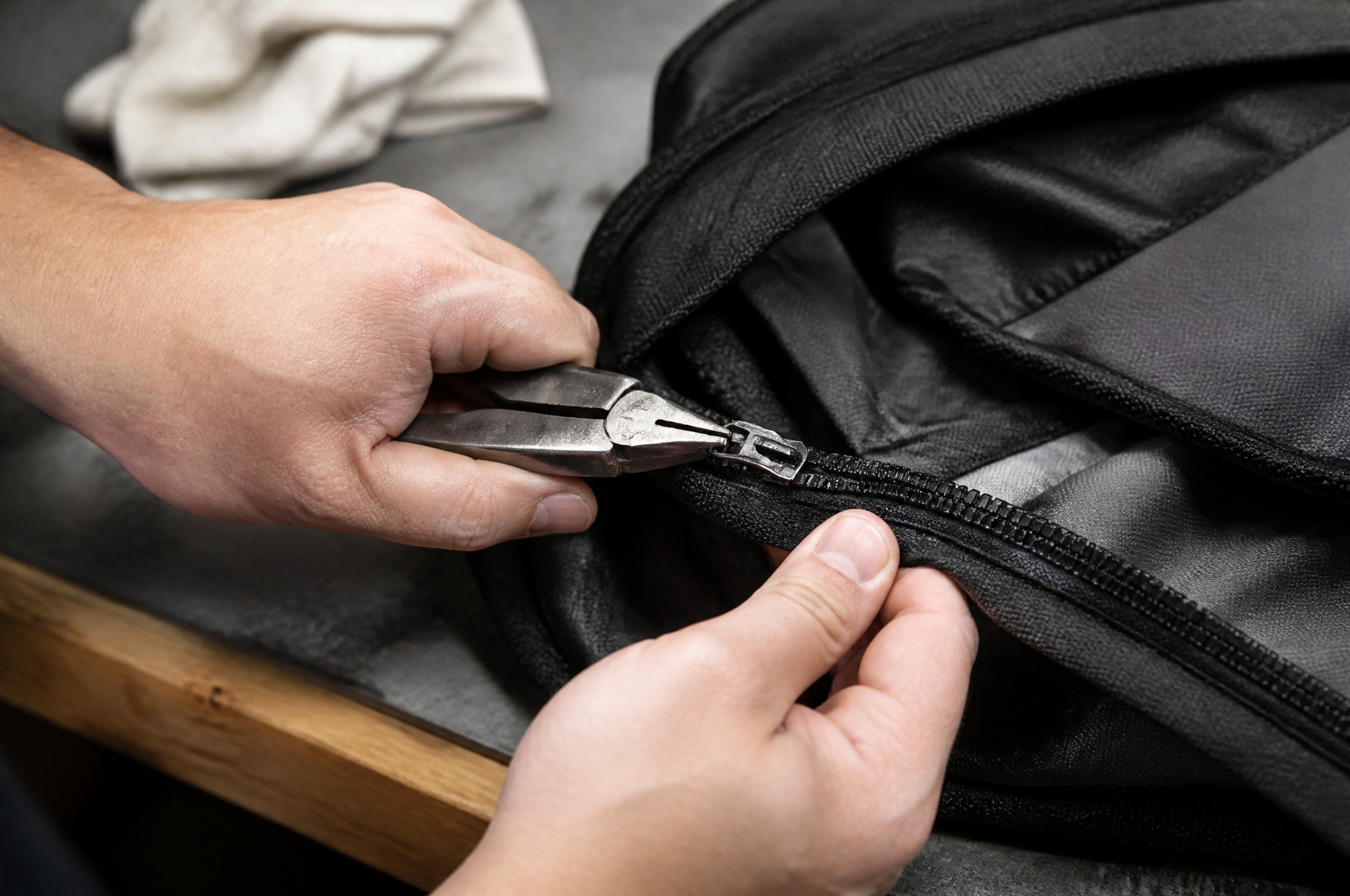
Parts-only resolution assumes a customer willing to fit a slider with a pair of pliers. Some are. Many are not, and a failed self-repair converts a 3 dollar part into a 1-star review plus a replacement, so you pay twice. Retail channels with counter staff handle parts well because an employee does the fitting. Direct-to-consumer channels handle them badly below a certain age and skill level.
Replacement-only resolution is clean but expensive, and on a 2 percent claim rate at 17 dollars per claim it can consume 4 to 6 percent of gross margin on an entry price point bag.
The middle route we see working: photo-approved parts for failures a user can fix in under ten minutes, and full replacement for structural failures such as strap anchor separation or a torn sleeve seam. Publish the split in the warranty so the customer knows which path applies before they call.
Where the parts approach breaks
A limitation worth stating: parts programs reduce cost per claim, not the number of claims. If the underlying design is producing repeat failures in the same place, a spares kit just makes the failure cheaper to service. It also shifts labour onto the customer, and in the EU that can conflict with consumer expectations of a remedy without effort. We tell brands to run a parts program only when the failure is a wear item, never when it is a design defect.
A Spares Program Checklist
A claim log with component names matching the bill of materials, not generic descriptions
The top five failure components identified from actual data, not assumption
Spares quantity calculated from claim share, with a 40 percent buffer on the top two items
Colour and finish locked to the bulk production run
Cartons labelled with PO number, production date, and component code
A one-page fitting guide with photographs, in the retail language of the market
A cut-off date for reordering spares, typically 12 months after the last bulk shipment
A quarterly review that feeds the top failure back into the design brief
Storage conditions stated, because polypropylene adjusters degrade in direct sunlight
That reorder cut-off line is the one buyers forget. Tooling for a moulded adjuster can be retired, and a brand that needs parts 26 months after launch may find the part discontinued. We hold moulds for active programs and tell buyers in writing how long we will hold them.
Set Up The Parts List With Your Factory
At Tianqin we now issue a spare parts schedule with every laptop backpack order over 5,000 units: component code, quantity used per bag, unit spare price, and the date after which we will no longer guarantee availability. It costs a buyer nothing at order stage and saves the argument later. On a recent 17-inch program, the schedule identified a strap keeper that appeared twice per bag and had a 0.09 dollar replacement cost, which changed the client's warranty wording from replacement to repair for that specific failure.
Send us the claim data you have, even if it is only 20 tickets, and we will map it to our bill of materials and propose a spares basket with quantities and per-unit pricing at your order volume. If your design has a component we consider a predictable wear item, you will hear about it during sampling rather than after your first returns report.
Contact [email protected] or visit www.tianqinbag.com to request samples, get a factory quote, or start an OEM/ODM project with Quanzhou Tianqin Bags Co., Ltd. Sampling takes 7-15 working days, and we can quote the spares schedule in the same round. Seventeen years of bag manufacturing in Quanzhou, exports to more than 50 countries, SGS test reports available on request.
 Hot News


