EN



The first question buyers ask when we send a carton drawing is whether the box can be smaller. It usually can, by two or three centimeters on each side, and that change is worth more money than most buyers expect. It also changes how many bags arrive without a crushed back panel. Carton configuration is one of the few freight decisions a buyer still controls after the bag is designed.
Why the Carton Is a Cost Decision
A laptop backpack is mostly air. A 25 L model with a padded back panel, foam-lined laptop sleeve, and structured base ships folded flat, and the fold is what the carton has to accommodate, not the bag's usable volume.
Take a standard configuration: 62 x 45 x 30 cm, 10 pieces, 14.2 kg gross. That is 0.0837 cubic meters per carton, or 8.37 litres of shipping volume per bag. The bag itself holds 25 litres. The ratio between those two numbers is the whole freight conversation.
Change the carton to 60 x 42 x 33 cm and you get 0.0832 cubic meters, almost identical. Change it to 58 x 40 x 30 cm and you get 0.0696, a 17 percent reduction, with 8 pieces per carton at 11.6 kg. Seventeen percent of a container is seventeen percent of the ocean freight, and on a 1,000-unit order that is real money for a carton that still passes a drop test.
The catch is at the bottom of the stack. A carton is a structural component, and shrinking it without changing the board grade moves the failure from the freight invoice to the claim report.
Volume Weight: The Divisor That Sets the Bill
Air and express shipments are billed on chargeable weight, which is the greater of actual weight and volumetric weight. Volumetric weight is length times width times height in centimeters, divided by a divisor. Most air cargo uses 6,000. Some express products use 5,000.
A divisor of 6,000 means one cubic meter equals 166.7 kg. That is the density threshold. Cargo denser than 166.7 kg per cubic meter is billed on actual weight. Cargo lighter than that is billed on the space it occupies.
Backpack cartons sit almost exactly on the line. The 62 x 45 x 30 carton at 14.2 kg gives 14.2 divided by 0.0837, which is 169.7 kg per cubic meter, so actual weight governs by a thin margin. The 58 x 40 x 30 carton at 11.6 kg gives 166.7 kg per cubic meter, exactly on the threshold. The 60 x 42 x 33 carton at 11.6 kg gives 139 kg per cubic meter, which means volumetric weight governs and the airline charges 13.86 kg instead of 11.6 kg, a 19 percent surcharge for a carton that looked smaller.
This is the counter-intuitive part of carton work. Shrinking a carton does not always reduce air cost, because the divisor cares about the ratio, not the absolute size. If a smaller carton means fewer bags per box, the density falls and you pay for air. The configuration that wins on sea freight is not always the one that wins on air.
Sea freight ignores weight for this product category. A 20 ft container will hit its cubic limit long before it hits its 28-tonne weight limit with backpacks, so on ocean the only thing that matters is cubic meters per bag.
Carton Size Against Damage Rate
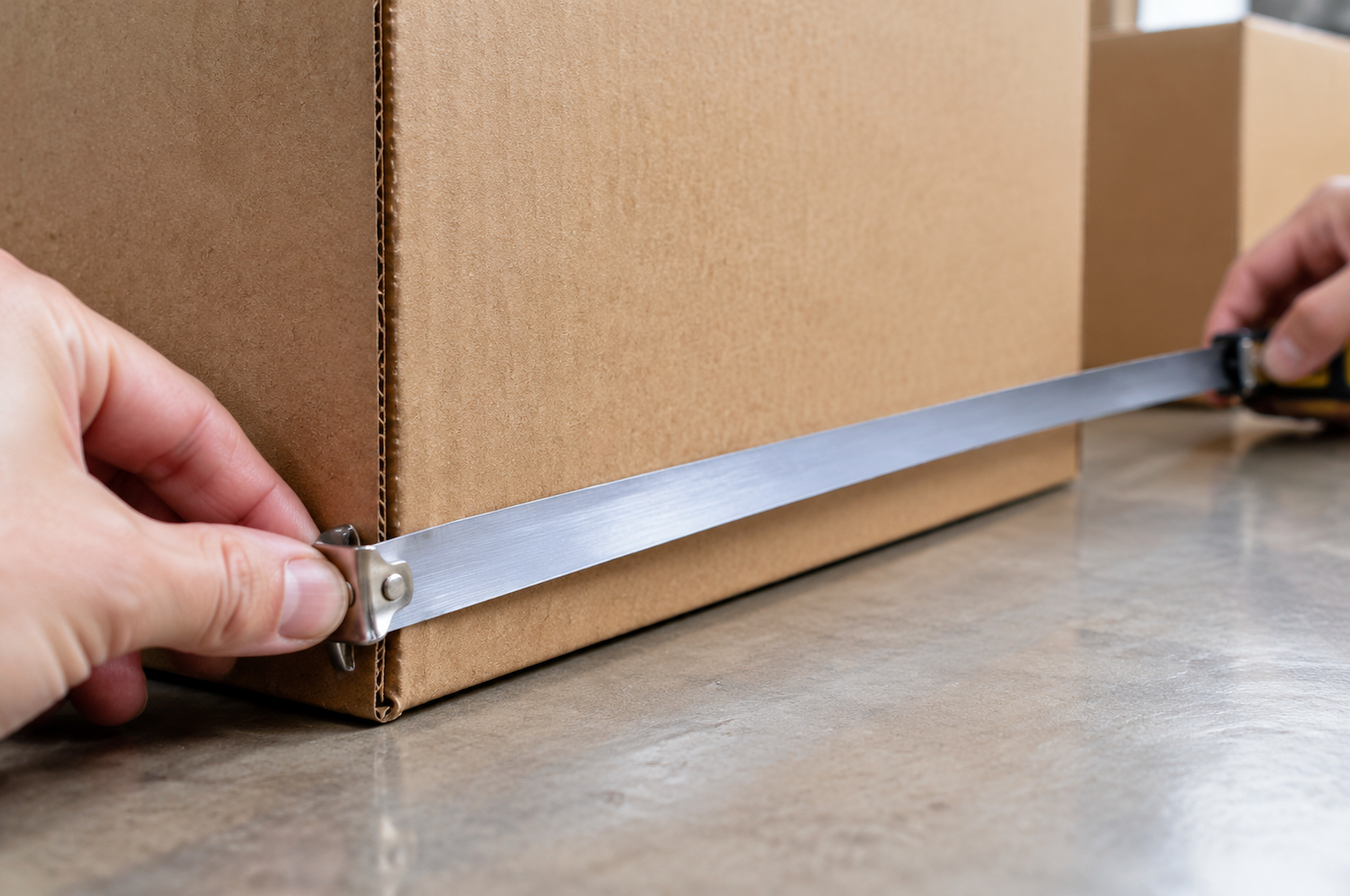
Board grade and stack height decide whether the bottom layer survives. A 5-ply carton with an edge crush test value of 32 lb per inch is our standard for export backpack cartons. A 3-ply carton at 26 lb per inch costs about 0.18 USD less per box and looks identical on the outside.
The difference shows up after four weeks at sea. Corrugated board loses compression strength in high humidity, and a container crossing the tropics can sit at 85 to 90 percent relative humidity for days. Under those conditions a box can lose 40 to 50 percent of its stacking strength through creep. A stack of seven cartons at 14.2 kg puts roughly 85 kg on the bottom box before that loss, and 85 kg becomes 170 kg of effective load once the board softens. The bottom carton bulges, the bags inside take a compression set along the back panel, and the retailer photographs a dented product.
Our rule is that the box compression test value should be at least three times the static load on the bottom carton. On a seven-high stack of 14.2 kg cartons, that means a target around 255 kg of compression strength, which 5-ply ECT-32 meets and 3-ply ECT-26 does not.
The claims data supports the rule. On programs where we moved from 3-ply to 5-ply, carton crush claims fell from around 1.8 percent of units to under 0.4 percent. The board upgrade cost 0.18 USD per carton, or 0.018 USD per bag. The claim cost it prevented was a return, a replacement, and a retailer chargeback that rarely comes in under 25 USD per unit.
Configurations That Work for Backpacks
Carton footprint should be chosen against the pallet, not in isolation. A standard pallet is 1,200 by 1,000 mm. A 62 x 45 cm footprint lays two cartons per layer with 40 percent of the pallet empty. A 60 x 42 cm footprint lays four per layer, doubles the pallet load, and holds the pallet to a stable 1.6 m height at six layers.
Three more configuration rules we apply.
Pack a maximum of 22.7 kg per carton. Above that, manual handling injuries rise and many fulfillment centres reject the carton outright.
Keep the longest side at 63.5 cm or under unless the program is deliberately oversize, because several e-commerce fulfillment networks surcharge or refuse longer cartons.
Pack folded bags with the back panel flat and the shoulder straps rolled inward, then interleave a sheet between layers. Branded hardware scratches when metal contacts metal for 30 days.
Print the shipping mark, the piece count, the gross weight, and the SKU on two adjacent sides, so the carton is readable whichever way it lands.
Confirm the carton drawing at sampling, not at packing. A 1 cm change after the purchase order is a new die and a new pallet plan.
The limitation is worth stating. A smaller carton trades protection for cube, and there is a floor below which we will not go. On a 25 L model with a moulded EVA back panel we will not approve a carton height under 28 cm, because the panel takes a permanent set and the bag arrives with a curved back that no retailer will accept. We have lost orders over that position. It is still the right position.
A Carton Specification Checklist
Use this to review any carton drawing a supplier sends you.
Internal dimensions in millimeters, with a stated tolerance of plus or minus 5 mm.
Board construction by ply and edge crush test value, not by a vague grade name.
Pieces per carton, gross weight, and net weight, all three stated.
Stack height limit the factory actually uses in the container, not the theoretical one.
Drop test reference, such as ISTA 3A, and the drop height applied.
Pallet pattern, cartons per layer, and layers per pallet.
Whether the carton is floor loaded or palletized, because the answer changes the cubic total by 6 to 9 percent.
Artwork placement and barcode position, if the retailer requires a specific side.
Send the Carton Problem, Not Just the SKU
At Tianqin, carton drawings come out of the same 3D sampling process as the bag, so a buyer sees the folded bag, the internal dimension, and the pallet pattern before bulk. We build a pallet to 2.4 meters and leave it standing for 72 hours before approving a carton specification, because creep does not show up in an hour. We also consolidated our 25 L platform onto a 60 x 42 cm footprint two years ago, which cut 12 percent of the cubic volume per bag and raised pallet density from 120 to 192 bags.
Tell us your destination, your mode, and any retailer carton rules and we will return the bag specification with the carton math already done. Write to [email protected] or request a quote at www.tianqinbag.com. Sampling takes 7 to 15 business days, and the carton drawing is part of the sample, not an afterthought once the bags are finished.

 Hot News