EN



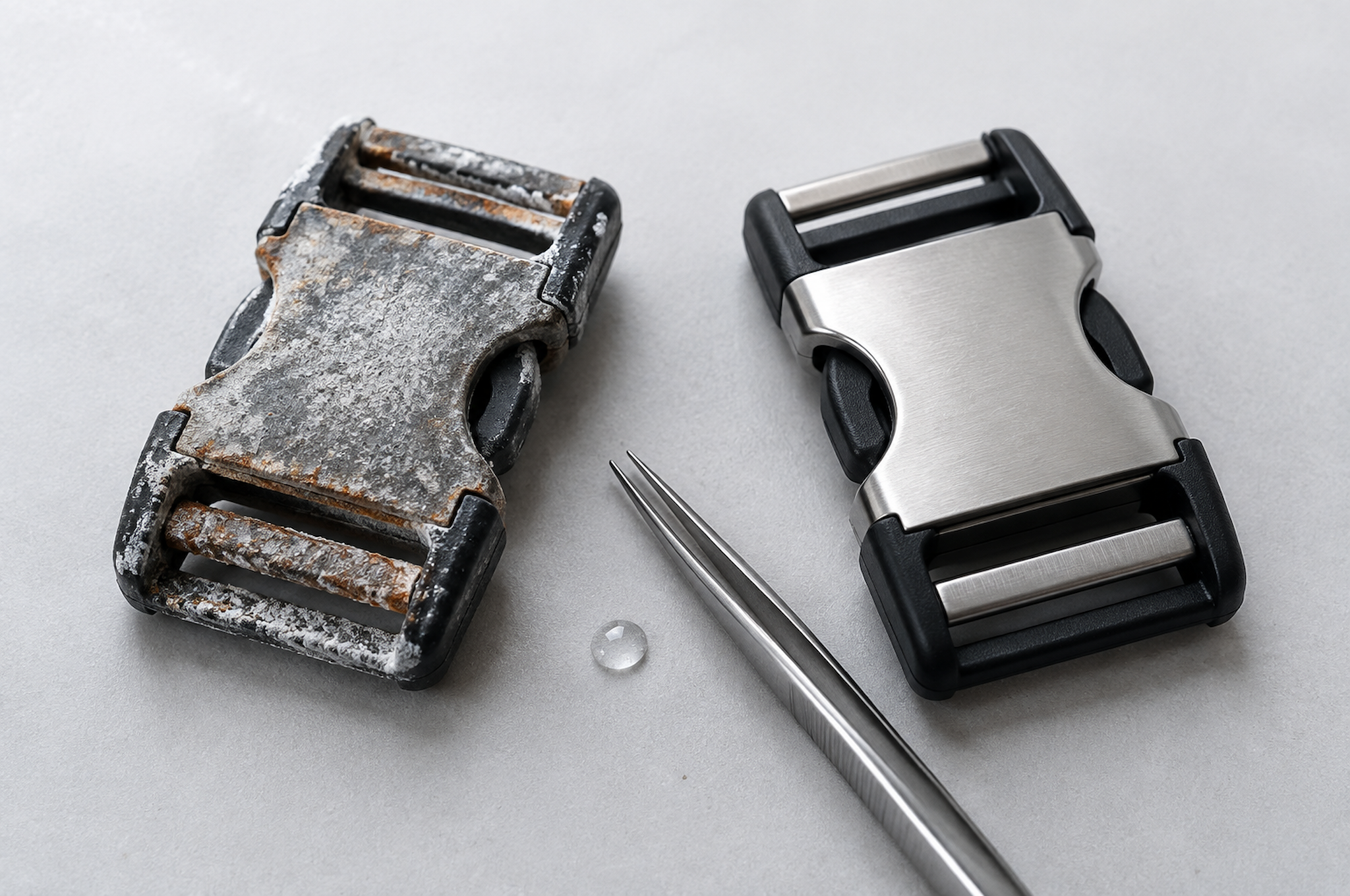
A distributor in Hamburg received 2,400 laptop backpacks in March and by June had 180 complaints about white spots on the buckle prongs and bubbling on the logo plate. The bag had never been near salt water. It had spent 24 days in a container, four weeks in a warehouse near the Elbe, and then a summer in shop windows. Hardware corrosion is a moisture story more than a sea story, and salt spray testing is how you find out before the carton ships.
What Salt Spray Testing Reproduces, and What It Does Not
A salt spray chamber atomises a saline solution into a fog and holds specimens in it at constant temperature. The standard is ASTM B117 or its ISO equivalent 9227, using a 5 percent sodium chloride solution at 35 degrees Celsius, with the collected solution at pH 6.5 to 7.2 and a fall-out rate of 1 to 2 ml per 80 square centimetres per hour.
The test is accelerated, and that is its weakness as well as its value. One hundred hours in a chamber is not equal to one hundred days at sea. The chamber gives a continuous wet film that real exposure only produces during condensation cycles, so it overstates corrosion on parts that dry out. It also understates crevice corrosion, since most backpack hardware failures start inside a joint the fog reaches poorly.
What the test does well is rank. Run the same buckle from three plating suppliers for 96 hours and the difference is unmistakable and repeatable. That is how we use it: as a supplier qualification and lot verification gate, not as a lifetime prediction.
Test Conditions and Hour Targets
Hours are the number buyers quote, and the number means nothing without a pass criterion attached. Our targets for laptop backpack hardware:
Zinc alloy buckles and adjusters, black nickel or electrophoretic coating: 72 hours, no substrate corrosion, function unaffected
Zinc alloy logo plates and badge holders: 72 hours minimum, 96 hours for coastal-market programs
Steel D-rings and hook plates, zinc plated: 48 hours, no red rust
Steel rivets and burrs, plated: 48 hours
Zinc alloy zipper sliders on metal zippers: 96 hours, because the slider sits on a wet shoulder strap path and against fabric that holds moisture
We test six pieces per hardware lot, cleaned with alcohol and handled with gloves, and we photograph each piece at 24, 48, and 72 hours so the report shows progression rather than a single end state.
Function is part of the pass criterion and is usually left out. A buckle with no visible corrosion that no longer releases under 30 N of pull has failed. We open and close each tested adjuster ten times after removal.
Plating Types and What Each Survives
The plating decides the outcome more than the base metal, and the cost differences are measured in cents.
Zinc plating on steel, 5 to 8 microns: 24 to 48 hours to white corrosion, cheap, fine for hidden rivets
Zinc plating with a clear passivation, 8 to 12 microns: 48 to 72 hours, the practical floor for visible steel parts
Nickel plating on zinc alloy, 8 to 12 microns: 72 to 96 hours, the standard for buckles and sliders
Black nickel over nickel: 96 hours and good appearance retention, our default on black hardware
Electrophoretic coating over zinc alloy: 120 to 240 hours, the best barrier we buy, with a slightly softer look
Powder coating over zinc alloy: high barrier but chips at edges, and each chip becomes a corrosion site
Antique brass and bronze finishes with a lacquer topcoat: appearance-driven, and the lacquer is the weak layer
Two practical rules. Zinc alloy cannot be protected the way steel can, because a zinc alloy die casting has porosity that a plated layer follows rather than seals. A pinhole in 8 microns of nickel on a porous casting becomes a corrosion cell that grows under the plating and lifts it, which is the bubbling a customer describes as peeling paint.
A thicker plate is not automatically better either. Above roughly 15 microns, build-up changes the fit on a small threaded part, and a buckle that no longer clicks is a return, so we specify a range rather than a minimum.
There is a real cost consequence. Moving a full hardware set from standard nickel to black nickel with an electrophoretic topcoat adds about USD 0.09 to USD 0.14 per bag at 3,000 units. On a program selling into a dry inland market with short storage, that money is hard to justify. On a program with coastal distribution and slow sell-through, we recommend it and put the reasoning in writing.
Corrosion During Shipping and Storage
Most corrosion claims we see are generated between the factory gate and the retail shelf, not in the customer's hand.
A 40-foot container crossing the tropics can reach 60 degrees Celsius inside during the day and drop to 25 at night. That daily cycle condenses moisture on metal, on the inside of the container roof, and inside the bag. A backpack packed with a carton insert holds that moisture against hardware for weeks, especially at the base.
Our standard countermeasures on export orders:
A 2 g silica gel sachet per polybag on any order with metal hardware, and two on 17-inch and tool models
Polybags with a vent hole, because a sealed bag traps condensation rather than excluding it
Carton liners on sea freight to humid destinations
Container loading with a moisture-absorbing desiccant blanket
Storage at the destination matters as much as transit. Plating that passed 72 hours in the chamber has shown white corrosion after five months in an unheated coastal warehouse, because the chamber never ran a wet-dry cycle with salt left on the surface.
That is the honest limitation of salt spray data: it tells you the plating system is competent, and it cannot tell you the part will look new after a year on a shelf in Bremen.
Hardware Inspection Checklist for Incoming Lots
A buyer without a chamber can still catch most problems. Run this at goods-in on a sample carton:
Confirm the plating type and thickness range on the supplier's test report, in microns, not as a description
Check for pinholes and skips by eye under a bright light at the inside of every curve, where plating throws poorly
Look at the parting line on die-cast parts, since a rough parting line holds moisture and starts corrosion
Operate every buckle and slider ten times and note stiffness or a click that does not engage
Wipe one part with a dry white cloth to check for plating rub-off, which indicates a thin or poorly bonded layer
Weigh a production part against a known good sample, as a 0.5 g drop often means a thinner casting rather than thinner plating
At Tianqin, every hardware lot is checked against the approved sample at goods-in, and we run salt spray on a coupon set from each new plating supplier before that supplier enters the bill of materials. We also keep six pieces of each hardware lot in a sealed bag with the lot number, so a claim two years later can be traced to the actual plating batch. Metal hardware is specified in zinc alloy by default on our business and travel lines, and we quote plating hours per part in the hardware schedule attached to the sample.
One buyer question we get often is whether zinc alloy hardware is acceptable at all, since a competitor offers steel. Zinc alloy is lighter and does not rust red, but it is more sensitive to plating quality, and a cheap casting with a thin plate is worse than a well-plated steel part. The answer is a tested plating spec, not a metal name on a quotation.
Put Plating Hours in the Purchase Order
Send us your hardware list and your destination market. We will map each part to a plating system with a tested hour count, give you the per-unit difference, and tell you which parts can safely stay on standard nickel.
Contact [email protected] or visit www.tianqinbag.com to request a sample with hardware salt spray data, get a factory quote, or start an OEM/ODM project with Quanzhou Tianqin Bags Co., Ltd. Sampling takes 7-15 working days, and we can include the hardware schedule with plating hours in the sample package. Seventeen years of bag manufacturing in Quanzhou, OEM and ODM exports to more than 50 countries, SGS test reports available on request.


 Hot News