EN



A private-label brand in the UK opened a carton of 60 black 1680D backpacks and found pale grey lining panels with grey-brown smudges where the laptop sleeve rubbed the shell. Every bag in the carton had it. The fabric mill had supplied good shell, the lining was within tolerance, and the interaction between the two had never been tested by anyone in the chain. Colour tests are the cheapest insurance in bag sourcing and the most commonly skipped.
Why Crocking Shows Up After the Sale
Crocking is colour transferring from a fabric surface onto another surface by rubbing. On a backpack it happens in four places: the back panel against a white shirt, the shoulder strap against a light jacket, the lining against a laptop.
The mechanism is mechanical, not chemical. Dyestuff sits on the fibre surface, the surface is abraded, and loose dye particles move. Dark shades with heavy dye loading are worst, and cheap pigment dyeing is worse than vat or reactive dyeing because the pigment sits on the fibre rather than inside it.
A bag can pass a visual inspection at the factory and fail the third week of retail. That is the reason we treat crocking as a material approval gate rather than a finished-goods test.
Dry and Wet Crocking: Method and Ratings
Dry crocking follows AATCC 8 or ISO 105-X12. A white cotton test cloth is rubbed against the specimen for 10 cycles, which is 20 rubs, under a load of about 9 N, at one cycle per second. The test cloth is then compared to a grey scale and rated from 1 to 5, with 5 meaning no transfer.
Wet crocking uses the same machine with a test cloth wetted to 65 percent pickup. Wet results are always lower than dry, because moisture swells the fibre and releases dye, and because a damp cloth lifts surface pigment more easily.
Our acceptance values on laptop backpack fabrics:
Shell, dark shades: dry crock 4.0 minimum, wet crock 3.0 minimum
Shell, light shades and undyed: dry crock 4.5, wet crock 3.5
Lining against a laptop or tablet: dry crock 4.5, wet crock 3.5, no exception
Webbing straps, which rub on clothing all day: dry crock 4.0, wet crock 3.0
PU coated fabric faces: dry crock 4.0, plus a separate adhesion check because coating rubs off as a film rather than as dye
The 4.0 and 3.0 figures are stricter than the 3.0 and 2.5 that appear in many mill certificates. A 3.0 rating is a visible stain on a white shirt collar, and a shirt collar costs a retailer more than the backpack margin.
Sample preparation decides whether the number is real. Specimens are conditioned at 21 degrees Celsius and 65 percent relative humidity for at least four hours before testing, and we cut them from three different positions in the roll, not all from the same metre. Roll-edge to roll-centre dye variation is common on 600D Oxford polyester, and a single centre sample hides it.
Washfastness and Perspiration
Washfastness matters because buyers wash backpacks more than the industry assumes. A school or commuter bag goes into a machine at 30 or 40 degrees with detergent, and a bag that bleeds turns a pale lining pink in one wash.
We test to AATCC 61 method 2A or ISO 105-C06 at 40 degrees Celsius for 30 minutes with 10 steel balls, then rate colour change and staining of a multi-fibre strip. Our gate is 4.0 for colour change and 4.0 for staining on all fibres for shell and lining; webbing gets 3.5 because heavy dye loading on polypropylene is harder to hold.
Perspiration is the test buyers forget. AATCC 15 or ISO 105-E04 puts the fabric against an acidic and an alkaline solution that simulates sweat, then incubates it. A backpack back panel sits against a sweaty back for hours. A shell that rates 3.0 here will discolour at the panel where the foam touches, and the customer sees a brown patch on the inside of the bag, not on the outside.
Light fastness closes the set. AATCC 16 or ISO 105-B02 to 20 fading units is our baseline for any bag sold in a sunny market. A black 1680D nylon usually clears it easily. A bright red or orange polyester in a cheap dye can drop two grey scale steps in 40 hours of xenon arc exposure.
Dye Migration on Light Linings
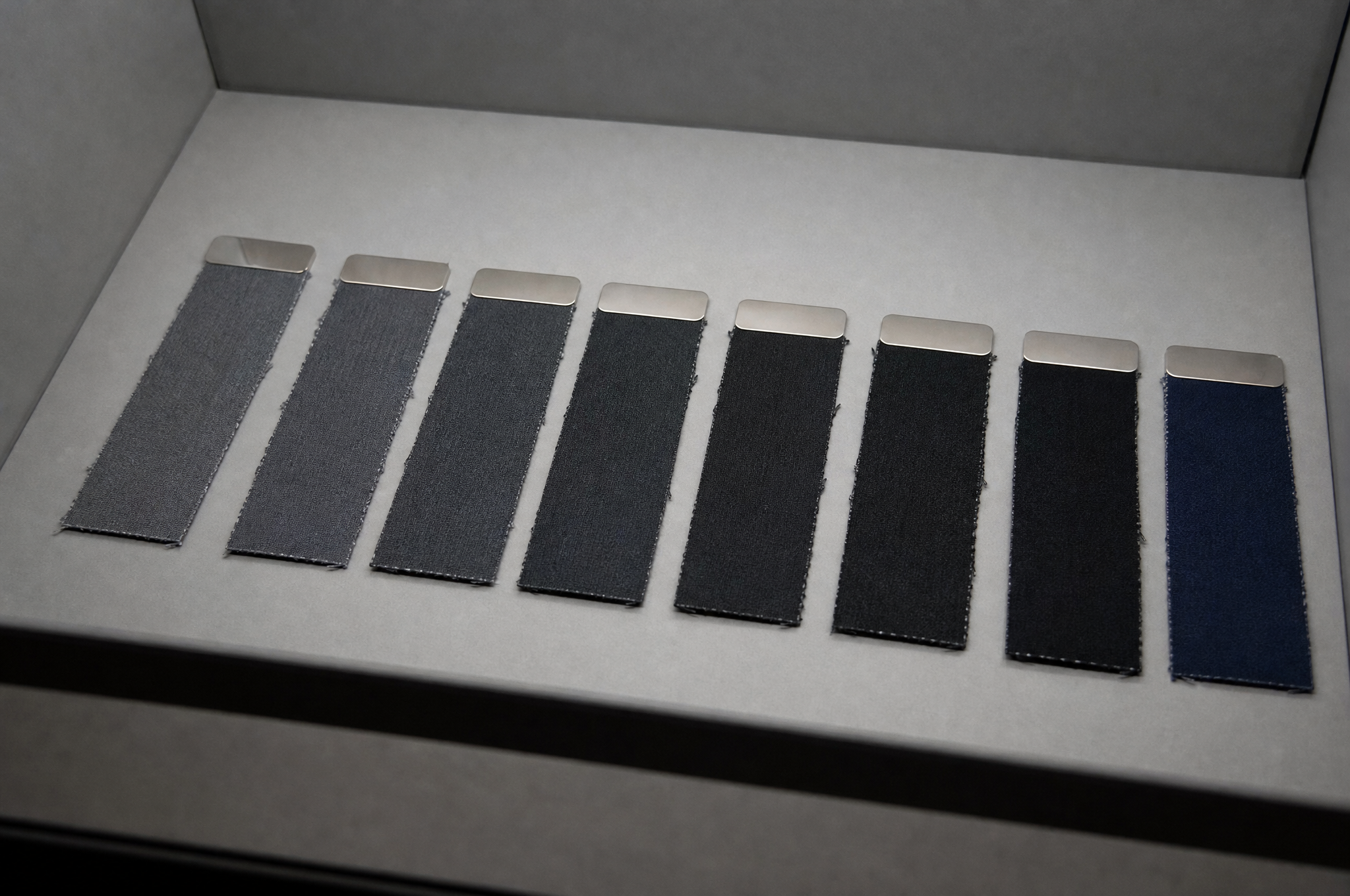
Migration is a different failure from crocking, and it is the one that damages a brand fastest because it appears in every unit of a shipment.
Two mechanisms cause it. The first is sublimation, where disperse dye on a dark polyester shell vapourises in heat and re-deposits on a light lining pressed against it. The second is plasticizer migration, where a soft PVC or low-quality PU laminate releases plasticiser that carries dye into an adjacent panel.
The classic case is a black 600D polyester shell with a light grey 210D polyester lining. Both materials are correct on their own certificates. Ship them in a container that crosses the equator, where internal temperatures reach 60 degrees Celsius for days, and the lining comes out mottled.
Our screen is a bake test. We laminate a 100 by 100 mm piece of shell against a piece of lining and hold them in an oven at 60 degrees Celsius for 48 hours under light pressure, then rate staining of the lining on the grey scale. Anything below 4.0 fails, and we then either change the lining to a darker shade, add a 0.02 mm PE film barrier, or switch the shell dye class. The film barrier adds roughly USD 0.11 per bag at 3,000 units, which is the cheapest of the three fixes.
For long sea freight we also specify an anti-migration liner bag on light-interior programs, plus a desiccant sachet per carton. A 20 to 25 day transit through the tropics with no desiccant is the single most reliable way to produce a migration claim.
A Fabric Approval Checklist You Can Run
Use this list when a mill or supplier sends a certificate, and check that the document answers each line:
Test method named, including the year version, not just "colourfastness passed"
Ratings for dry crock, wet crock, wash colour change, and wash staining given as numbers
Specimen count and where the specimens were cut from the roll
Conditioning conditions before testing, temperature and humidity
Grey scale reference stated as AATCC or ISO, because the two evaluate differently
Migration or sublimation result where a dark shell meets a light lining, stated separately from crocking
Light fastness result in fading units or hours, not as a verbal claim
Dye class named, such as reactive, vat, or pigment, since dye class predicts behaviour better than a single test number
One thing a certificate cannot tell you is how the fabric behaves after 20 washes and a summer in a car. We treat lab ratings as a screen and add a 3-wash in-house verification on any new lining colour before we approve a bulk order.
At Tianqin, we hold a 300 mm by 300 mm retained swatch of every shell and lining lot used in production, labelled with the lot number and mill, and we keep them for 18 months. When a claim arrives, we can test the exact material that went into the bag rather than a substitute from the mill's current stock. We also run the 60 degree bake test on every new shell and lining pairing before sampling, because this failure is cheaper to prevent at the material stage by a wide margin.
A buyer told us plainly that he had never asked a supplier for a migration test and had paid for two recalls. He now puts the requirement in the purchase order.
Lock Colour Requirements Into the Specification
Send us the shell shade, the lining shade, and the destination market. We will tell you which dye class and which lining construction can hold a 4.5 crock rating against a laptop, and what the barrier film costs if it is needed.
Contact [email protected] or visit www.tianqinbag.com to request a sample with crocking and migration data, get a factory quote, or start an OEM/ODM project with Quanzhou Tianqin Bags Co., Ltd. Sampling takes 7-15 working days, and we can run the bake test on your shell and lining pairing during the sample round. Seventeen years of bag manufacturing in Quanzhou, OEM and ODM exports to more than 50 countries, SGS test reports available on request.


 Hot News