
 EN



Three quotes arrive in the same week. One reads 8.40 USD FOB per unit, one 9.65, one 10.20, and all three promise 45-day lead time on a 1,500-piece order of a 25L laptop backpack. The spread is 21 percent and the spec sheets are nearly identical, because each supplier copied your RFQ back to you on new letterhead. Price cannot carry that decision alone, and a gut-feel shortlist cannot be defended to a manager or a board. A weighted scorecard can. This is the model we hand to buyers who are comparing us against two other factories, weights included, including the parts where we expect to lose.
Score Six Dimensions, Not Twenty
Long checklists feel thorough and produce nothing usable in a meeting. Six dimensions with fixed weights force the argument out into the open where it can be settled with a document.
Quality system and first-pass yield: 25 points
Total landed cost, not FOB price: 20 points
Lead time reliability and capacity fit: 20 points
Development and sampling capability: 15 points
Communication and documentation discipline: 12 points
Commercial terms and payment risk: 8 points
That totals 100. Anything you cannot measure through a document, a demonstration, or a dated record goes into one of the six or leaves the model entirely. A dimension called trust is a conclusion, not an input.
Why Quality Is Not Weighted at 50
Buyers new to bag sourcing want quality to carry half the score, since the product is the point of the exercise. In practice, a factory that scores 95 on quality and ships two to six weeks late twice a year will wreck a retail calendar no matter how good the stitching is. Weights reflect what actually breaks programs, and in our experience late and inconsistent beats beautiful and unreliable every time.
What Each Dimension Actually Measures
Quality system and first-pass yield means three checkable things: the AQL level the factory inspects to, its first-pass yield figure at final inspection, and whether in-line inspection sheets are filled hourly rather than at closing time. Ask for the last 90 days of internal reject data on any backpack program. A factory that cannot produce that data is not tracking it.
Our own figure at Tianqin sits at roughly 3 to 4 percent first-pass rejects on laptop backpack lines. That is honest rather than excellent. The main loss driver is zipper alignment around the front panel curve, and we have not automated that station out of the process yet.
Total landed cost means FOB plus freight volume weight, plus duty, plus the cost of defects that reach your customer. Two factories quoting 9.65 and 9.90 can reverse order once carton size enters the math. A 25L backpack packed 8 per carton at 62 x 44 x 30 cm carries a different volume weight from the same eight packed at 58 x 42 x 32 cm, and on air freight that difference is paid per kilo.
Lead time reliability and capacity fit means monthly output on your product family, not the factory's total output. A plant running 120,000 bags a month across school, travel, and cosmetic lines may have two laptop lines. Ask what share of one line your 1,500 pieces consumes and when that line is next free for a color change.
Development and sampling capability means 3D sampling, pattern ownership, and how many rounds are included in the fee. Factories that bill per round behave differently from factories that build two rounds into the sample charge.
Communication and documentation discipline means reply time, whether answers arrive with dimensions and part numbers instead of adjectives, and whether a change gets written down.
Commercial terms covers deposit percentage, balance trigger, and whether the factory will carry a claim reserve.
Put Anchors on Every Score
Judgment drifts toward whoever presented best. Write the anchor for 5, 3, and 1 before scoring anyone, then force every score to land on an anchor.
Score 5 on lead time reliability: last 12 shipments shown with planned versus actual dates, 11 within 3 days
Score 3: dates available on request, variance up to two weeks
Score 1: no shipment history offered, or dates refused
Score 5 on documentation: cutting records, in-line sheets, and needle logs produced in under 10 minutes
Score 3: produced after a search, with incomplete fields
Score 1: our QC is very strict, offered as the whole answer
Score 5 on cost: quote breaks out fabric, hardware, labor, overhead, and packing
Score 3: quote shows material and labor only
Score 1: one lump number with no structure
Run this across all six dimensions and the model does the arguing for you. A supplier that wins on price and loses eight points on lead time reliability is not a cheaper supplier. It is a supplier with a different cost structure and a stockout risk that you are financing.
Score the Quote, Then Score the Sample
Quotes describe intentions. Samples describe outcomes. Run the scorecard twice, once on documents and the call, once on the physical sample, then compare the two.
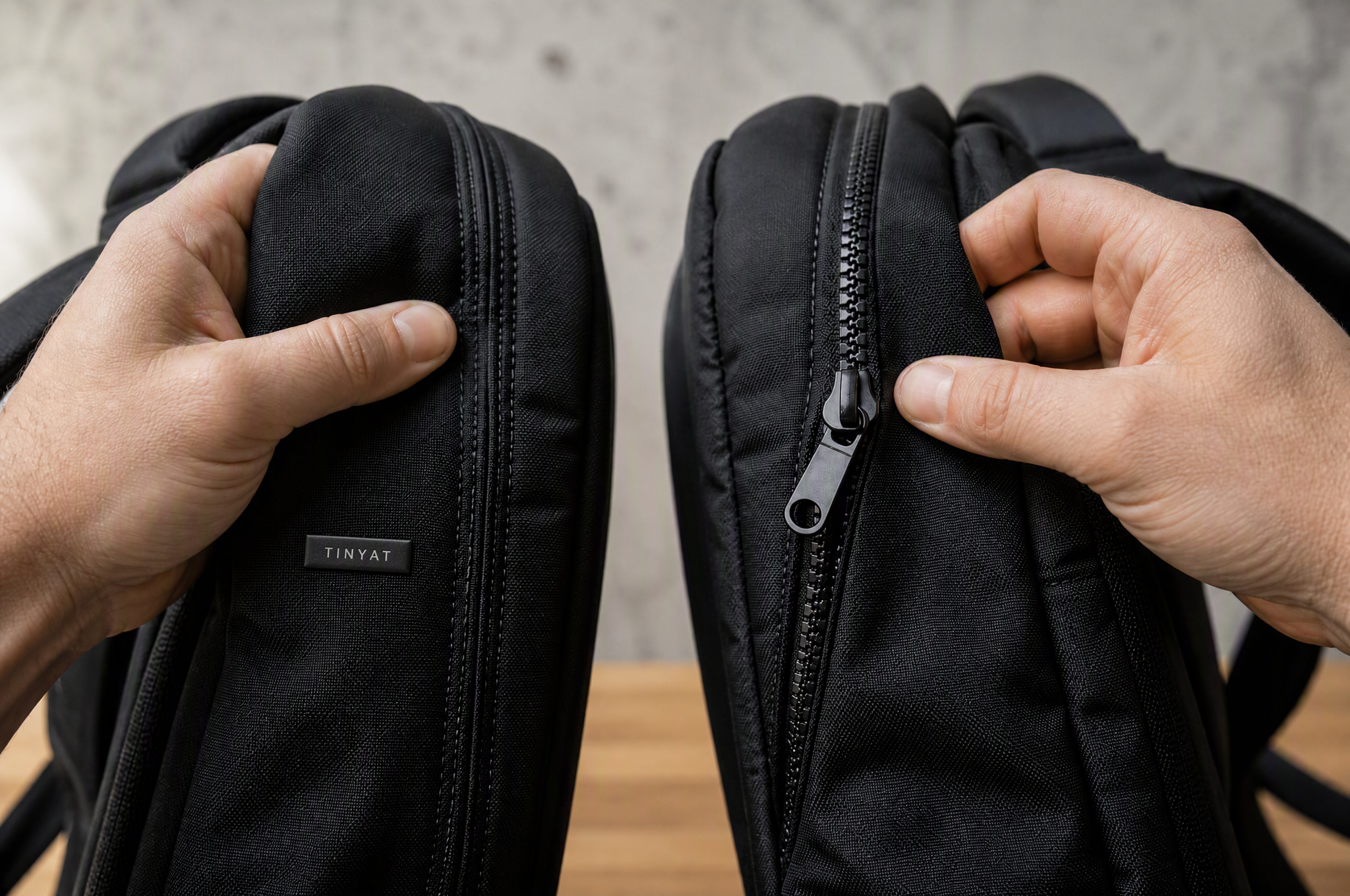
On the sample, measure rather than look. Panel symmetry within 3 mm across the front face. Stitch density at 8 to 10 stitches per inch on structural seams. Foam thickness in the laptop sleeve at 8 mm or better. A zipper that opens one-handed. Strap anchor bartacks that hold a 15 kg static load for one minute without visible stitch elongation.
At Tianqin we send the approved counter sample sealed and dated, and we keep an identical sample at the head of each line during the run. Stitch density at 8 to 10 stitches per inch is specified on the tech pack, not left to the operator, because it is the cheapest variable to control and the least forgiving when it drifts below 7.
When a buyer scores our sample below our quote, that gap is the most valuable data in the entire comparison. We would rather hear it in week three than discover it in carton 400.
Where the Model Fails
The scorecard will not tell you whether a factory still wants your order in year two, and it cannot price a relationship. It also punishes small workshops unfairly on commercial terms, because a 60-person plant simply cannot offer 60-day payment terms. Weight that dimension heavily and you will only ever buy from large exporters, which closes the door on the factories that will actually customise a pattern for you.
The second limitation is data quality. Half the inputs come from the supplier's own statements, and a polished sales team can score well on communication while the plant behind them is average or slow. Site verification is the only real correction, and it earns its cost on any program above 5,000 units. Budget two days on the floor, not one afternoon.
Run It on Us This Quarter
Take the three quotes on your desk, score them with these weights, and watch where the ranking moves once landed cost and lead time history are filled in properly. Then send the same sheet to [email protected] and ask us to complete it with our own numbers, including the dimensions where we expect to lose against a competitor.
We answer with documents rather than adjectives: AQL levels, first-pass yield, line allocation by month, carton dimensions, and shipment history. Quanzhou Tianqin Bags Co., Ltd has built bags for 17 years and exports to more than 50 countries, and samples run 7 to 15 business days from approved artwork and materials. Factory capability, material options, and product lines for laptop backpacks are listed on www.tianqinbag.com.


 Hot News


