EN



Two factories send nearly identical photo sets: same machines in a row, same warehouse racks, same smiling QC team at a table of backpacks. One of them can hold a 2 mm cutting tolerance across 8,000 units and the other cannot, and the photos will not tell you which is which. A site audit answers questions the paperwork cannot. What follows is the sequence our own customers run when they visit our Quanzhou plant, and the points worth stopping for at each station.
Count Equipment Running, Not Listed
Ask for the equipment list, then walk the floor and count what is switched on. A plant advertising 14 cutting machines may be running 9, with the rest reserved for a different product family. Neither number is dishonest, but only one of them is your capacity.
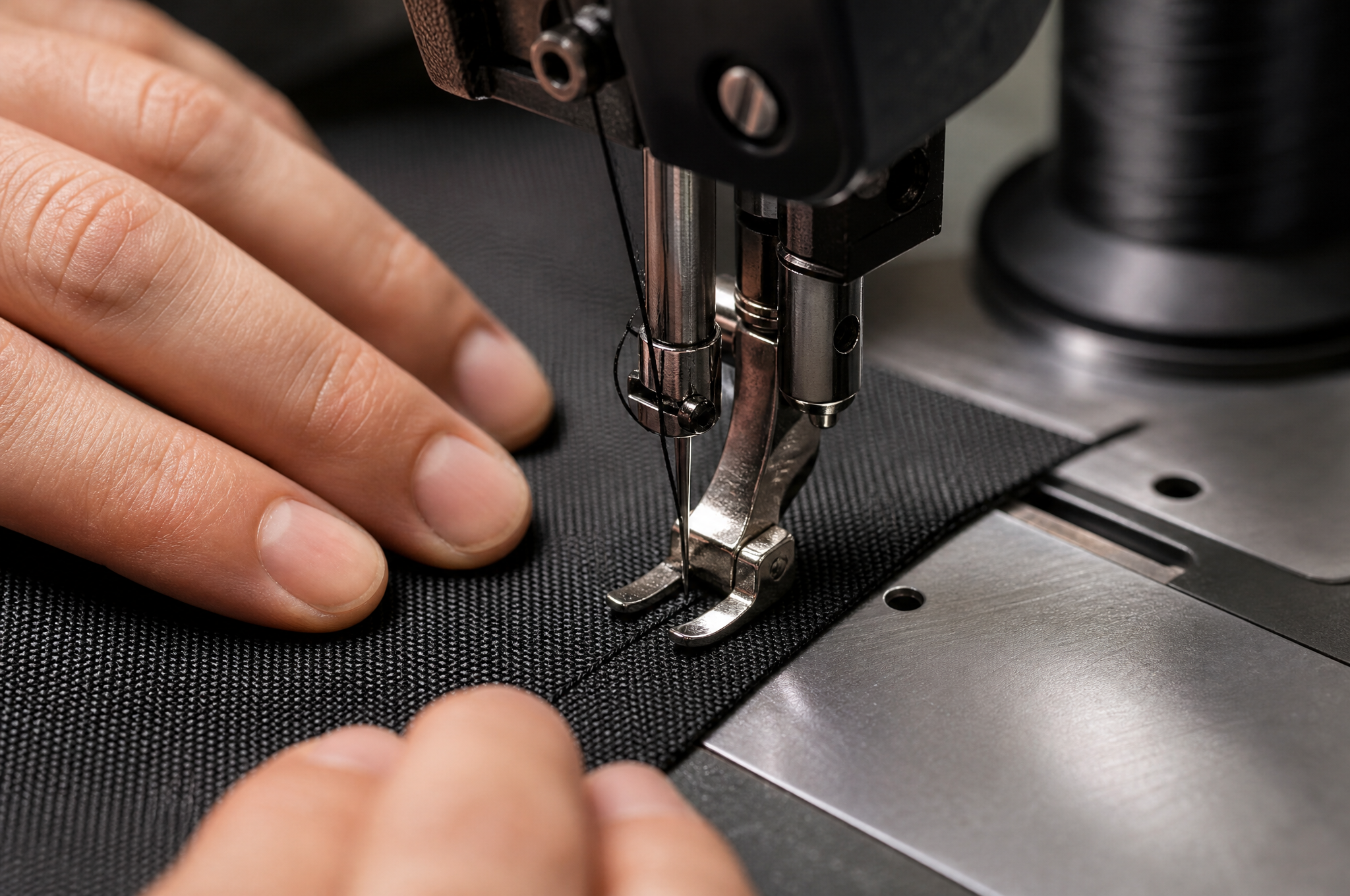
Look at the age and the maintenance state of the machines that will actually touch your order. A double-needle lockstitch with a worn feed dog will pucker 600D Oxford on every panel, and no amount of final inspection fixes puckering after assembly.
At Tianqin we run automated cutting machines for the main panels, a hanging conveyor system for work-in-progress movement, and semi-automated assembly lines for the body join. The automation matters most at cutting, where a 2 mm drift on a 40-panel backpack multiplies into a bag that will not sit square.
Ask one direct question: which machines are dedicated to laptop backpacks this month? A factory that makes school bags, coolers, and cosmetic pouches on the same lines will change over tooling for your run, and changeover is where the first 200 units get made at the wrong setting.
Line Layout and Material Flow
Walk the line backward, from packing to cutting. You are looking for the number of times a bundle of panels turns around, because every reversal is a chance for a mixed panel to enter the wrong bag.
A clean laptop backpack line moves in one direction: cutting, edge binding, zipper attach, lining sub-assembly, body join, strap attach, bartack, trimming, final check, packing. When you see cutting output stacked beside the packing tables, panels are traveling twice and nobody owns the middle.
Count the buffer between stations. A buffer of 40 to 60 pieces per station absorbs normal fluctuation. A buffer of 400 means a bottleneck upstream is being hidden, and your promised 45-day lead time is built on a line that cannot balance itself.
Ask where the counter sample hangs. Ours sits at the head of each line in a sealed bag with the approval date written on it. If the sample lives in an office drawer, the operators are working from memory and the QC team is working from a different memory.
In-Process Records and Traceability
This is the part of an audit that separates a factory from an assembly shed. Ask for three documents and see how long they take to produce.
The first is the cutting record: fabric roll number, shade, panel count, and the operator's signature. Without it, a shade complaint in carton 300 cannot be traced to a roll, and the answer becomes an argument.
The second is the in-line inspection sheet, filled hourly, not daily. We record stitch density, needle condition, and first-pass yield per station. A sheet with one entry per day is a form filled at closing time.
The third is the needle and broken-part log. Snapped needles end up in bags. A plant that logs needle changes by machine and time can contain the risk; a plant that does not is relying on luck.
Ask to see a carton label from a shipment that left last month and trace it back to a roll. If the trail stops at "we know our supplier", the traceability is a story rather than a system.
Calibration and Machine Settings
Calibration is unglamorous and it decides whether two bags made six weeks apart match. Ask when the sewing machines were last serviced, and ask to see the tension gauge check record.
We calibrate our cutting and pressing equipment every 6 months and check zipper tape tension on a test piece before every new color run. That check costs about 10 minutes per run and it prevents the ripple that reads as a wavy zipper line on a finished bag at retail.
Look at the stitch density on a bag pulled from current production, not from the sample room. We spec 8 to 10 stitches per inch on structural seams and 10 to 12 on webbing attachments. A machine running at 6 stitches per inch on a shoulder joint will pass a visual check and fail in use.
Check the needle gauge against the fabric. A 12 gauge needle on 1680D ballistic nylon leaves visible holes at the seam line, and those holes are permanent.
Worker Skill by Station
Ask for the skill matrix posted at the line. It should show each operator, the stations they are certified on, and the date of the last assessment. In a plant of 380 workers, the difference between a certified bartack operator and a substitute covering a break is the difference between a strap that holds 15 kg and one that opens at 9 kg.
Watch the bartack station for two minutes. It is the highest-load, lowest-tolerance operation on a laptop backpack, and it is still hand-fed even in a semi-automated line. Our own limitation is exactly here: automated cutting gives us repeatability, but the shoulder anchor bartack depends on the operator's placement, so we staff that station with the two most experienced people on each line and never rotate it during a run.
Ask what happens when a station falls behind. If the answer is that an untrained operator is pulled in, the audit has found the real quality risk, and it will not appear in any document.
The Audit Checklist You Can Walk With
Score each line as pass, fail, or not shown. A not-shown answer is a fail.
Equipment list matches machines running on the floor
Machines dedicated to your product family this month, named
Daily output capacity stated per line, in pieces
Material flow in one direction with no reverse travel
Work-in-progress buffer under 100 pieces per station
Approved counter sample sealed and dated at the line head
Cutting record ties roll number to panel count
In-line inspection sheet filled hourly, not daily
Needle and broken-part log kept by machine and time
Carton label traceable to fabric roll within one working day
Calibration records current for cutting and pressing equipment
Zipper tension checked per color run
Stitch density verified on production units, not samples
Skill matrix posted with assessment dates
Bartack station staffed by a certified operator
Finished goods area separated from work-in-progress
Carton drop test performed on a sample from current packing
Factory holds valid social compliance or customer audit reports
Book the Visit Before You Need It
The most useful audit happens before a problem, when the factory has no reason to stage the floor. Give 5 working days of notice, ask for production to be running on your product family that day, and bring your own current sample to compare against what the line is building. Quanzhou Tianqin Bags Co., Ltd has manufactured bags for 17 years and exports to more than 50 countries, and the sequence above is the one our own customers run on us, with no stations closed off.
If a visit to Quanzhou is not practical this quarter, we run the same checklist as a documented remote audit with dated photos at each station, and we send the approved counter sample with the shipment. Write to [email protected] to arrange either format. Sampling runs 7 to 15 business days from approved artwork, and factory capability, materials, and product lines are on www.tianqinbag.com.

 Hot News