EN



The show floor opens at nine and by two in the afternoon every booth looks the same: rows of backpacks, a banner, a stack of catalogues, and a salesperson asking where you are from. Buyers who arrive without a target list spend three days collecting 40 catalogues and leave with no comparable data. Buyers who arrive with a shortlist, five fixed questions, and a scoring sheet leave with three factories worth a sample order. The difference is preparation done in the two weeks before travel, not effort spent on the floor.
Build the Target List Two Weeks Out
Start from the exhibitor directory, not from the aisle. Export the list, filter it to bag and luggage halls, and cut it to a maximum of 20 booths you will actually visit, with 6 held as backups.
Filter on four things before you walk. Does the exhibitor list backpacks as a main category rather than a side item. Does its stated capacity support your annual volume. Does it show OEM or ODM capability rather than finished-product wholesale only. Is its product look adjacent to your price band, since a factory tooled for 6 USD promotional bags will not enjoy building a 22 USD technical daypack.
Then rank the 20 into three groups. Group A gets 30 minutes, group B gets 15, group C gets a 5-minute catalogue drop. Walking a hall without this split means you will spend your best energy on whichever booth had the most visible banner.
Book meetings for the top eight before the show opens. An appointment converts a 10-minute pitch into a 30-minute conversation with someone who brought the right colleague.
Plan the walking route by hall, not by ranking, and leave 40 minutes of slack in the morning and afternoon. A 20-booth list at 15 minutes average plus travel between halls is a full day, and most buyers try to do it in four hours and end up skimming the top of the list.
Walk the Hall in a Fixed Order
Start with Group A while your attention is fresh, ideally in the first two hours after opening when sales staff have not yet been worn down by a day of questions. Energy is the scarce resource at a trade fair, not time, and the questions you ask at booth 14 in the late afternoon will be worse than the ones you asked at booth 2.
The Booth Visit Structure
A 15-minute booth visit has five parts and it is worth holding to the order.
Minute 1 to 3: state your program in numbers, not adjectives
Minute 3 to 6: ask what they make most of, not what they can make
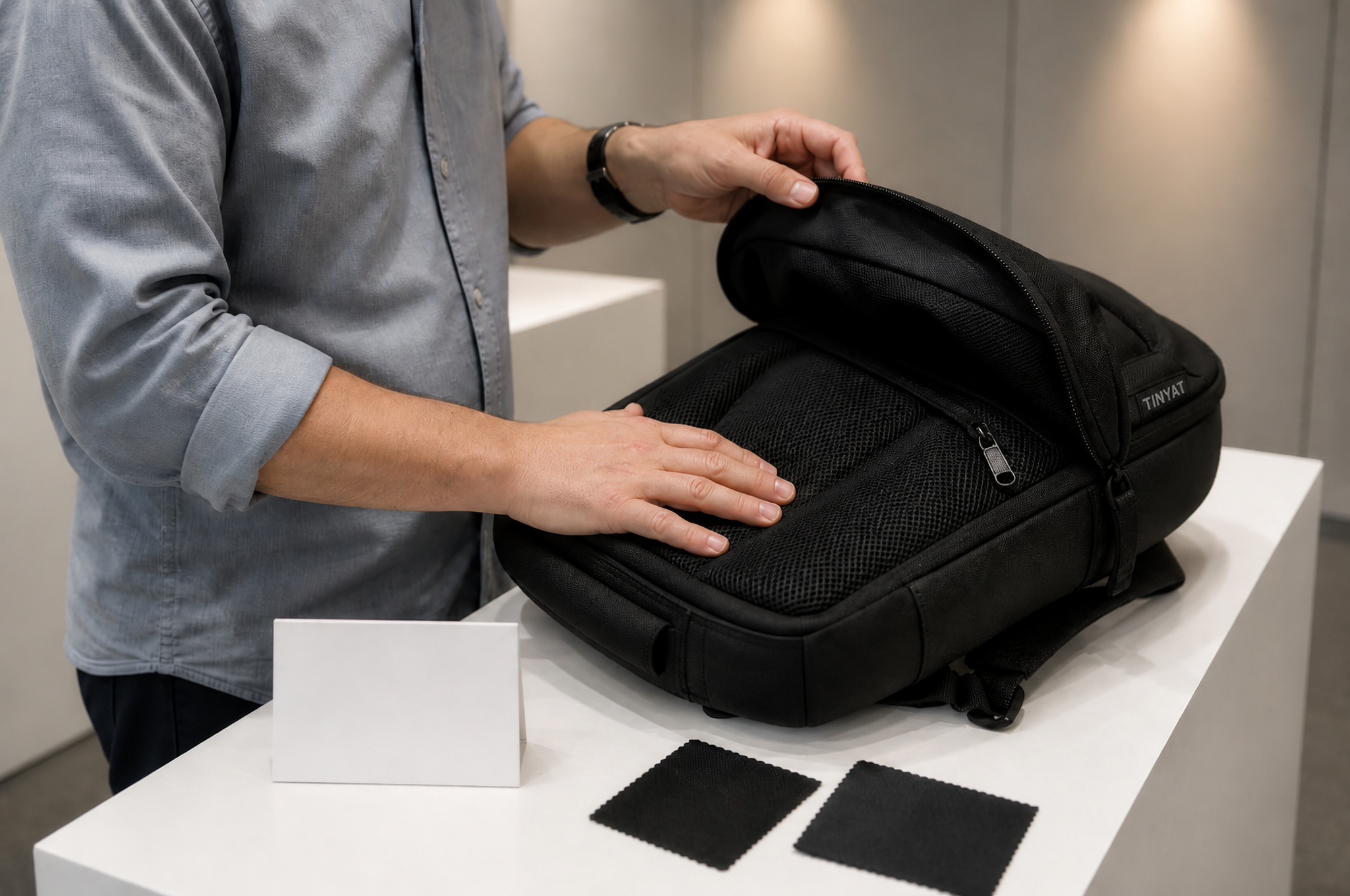
Minute 6 to 10: handle one sample and inspect the load points
Minute 10 to 13: ask your fixed questions
Minute 13 to 15: agree the exact next step and the date
Opening with volume and destination works because it changes what the salesperson shows you. Saying "we buy 8,000 laptop backpacks a year for Germany and the UK, 25L, 1680D shell, retailing at 89 EUR" produces a different conversation from "we are looking for backpacks".
While handling the sample, ignore the outer fabric for 30 seconds and turn the bag over. Look at the bartack at the strap anchor, the seam allowance inside the main compartment, whether the lining is cut on the bias, and whether the zipper tape is flat at the curve. Those four points carry more information than the whole front panel.
Five Questions That Produce Real Answers
Generic questions get generic answers. These five are harder to dodge.
What percentage of your monthly output is laptop backpacks, and how many lines run them
What is your first-pass yield at final inspection on your last backpack program
Which machines are automated in your plant, and which stations are still hand-fed
What is your sampling window from approved artwork, and how many rounds are included
Who owns the pattern and the tech pack after development
The last question matters more than buyers expect. A factory that reuses your pattern for other customers will not say so directly, but the answer about ownership and about whether tooling is charged as a one-time item usually reveals the practice.
Ask the second question twice, in different words, later in the conversation. Inconsistent answers on yield are common and informative.
What to Record Before You Leave the Aisle
Photograph the sample and the spec card together, then dictate a 30-second voice note on the aisle with the booth number and the three facts you want to remember. Catalogues alone lose their context by day two.
Record these fields for every A-group meeting, in a single sheet you fill in on the spot.
Company name, hall, booth, contact name, and direct email
Product family confirmed with a photo
Monthly capacity on that family, in pieces
Sampling window in days, and sample fee
Minimum order quantity per color and per model
Certification held: SGS reports, REACH, current audit
Two things they do well, one thing that worried you
Agreed next step and date
Any booth where you cannot fill six of those eight fields in 15 minutes is a booth that was pitching, not answering.
The Follow-Up Cadence
The show ends and 80 percent of buyers go quiet. Be in the other 20 percent and you will get better pricing, faster samples, and a real factory contact rather than a shared sales inbox.
Day 1 after the show: a short email restating your requirement in one paragraph, naming the booth, and asking for a quote by a stated date
Day 3: send your tech pack or a reference photo, and ask the two questions you did not get answered
Day 7: if no quote, one follow-up by email plus a message to the contact's direct channel
Day 10: ask for the sample timeline and the counter sample cost, in writing
Day 21: if the sample is running, ask for a dated photo of it in production or in the sample room
Two follow-ups without a substantive reply is an answer in itself. Factories that want a program reply within 72 hours during show season, because they know their competitors are also in the buyer's inbox.
Use the Show as a Filter, Not a Decision
No award should be made on a booth conversation. A show gives you a shortlist and a face; it does not show you a cutting table, a calibration record, or a line running your product. The limitation is structural: every booth at a trade fair is a staged environment, and the plant behind it can be excellent or average in ways the display cannot reveal.
Plan one factory visit inside 90 days of the show, or ask for a documented remote audit with dated photos per station. That step is what turns a good conversation into a supply decision.
Meet Us on the Floor or in Quanzhou
Quanzhou Tianqin Bags Co., Ltd has manufactured bags for 17 years and exports to more than 50 countries, and we run laptop backpack programs on automated cutting, a hanging conveyor system, and semi-automated assembly lines. Send your show shortlist to [email protected] and we will tell you honestly which of your five questions we can answer with documents this week.
Sampling runs 7 to 15 business days from approved artwork, so a show conversation in spring can still be a landed sample before your autumn range review. Materials, product lines, and factory information are on www.tianqinbag.com.
 Hot News