
 EN



A UK retailer rejected 1,800 laptop backpacks at their distribution centre because the care label was printed in English only and the order was destined for Ireland and the Netherlands as well. The bags were compliant on substances. The labels were not usable. Relabeling in a third country costs more than the original label run and it pushed the launch by three weeks. Labeling is the cheapest part of a backpack order and the fastest way to lose one.
What EU law requires, and what it does not
The core EU instrument for textile labeling is Regulation 1007/2011 on textile fibre names and related labeling. It sets the names you may use for fibres, the requirement to declare fibre composition, and the duty to declare composition accurately.
It does not cover care instructions. Care labeling is generally voluntary at EU level and is run through the GINETEX symbol system, but individual member states and, more importantly, individual retailers treat care symbols as mandatory. In practice you should treat them as mandatory.
Country of origin marking on textiles sold inside the EU is not a general requirement under that regulation. That does not mean origin is optional. Customs documentation requires it, some member states apply their own rules, and every retailer we work with requires a country of origin on the product or the packaging. We print it.
One more boundary worth stating plainly. The regulation applies to textile products, and a laptop backpack is a mixed product. Its textile surfaces fall inside the scope. Its foam, zippers, plastic buckles and metal hardware do not require fibre declarations, but a retailer's packaging and marking rules usually apply to the whole item.
Fibre content: names, percentages and tolerances
Fibre names must come from the official list. Generic marketing terms are not allowed. Write polyester, not performance fabric. Write nylon or polyamide, not weatherproof weave.
Percentages must add to 100 for the whole product, and the composition must be declared for each distinct textile part. In a laptop backpack that usually means four separate declarations: shell, lining, webbing or straps, and mesh where a mesh panel is used.
Tolerance rules matter for accuracy. EU rules allow a small tolerance for manufacturing variation, but a declared figure that is clearly wrong is a compliance failure, not a rounding issue. If you declare 100 percent polyester on a shell and the mill run is a 65/35 polyester-cotton blend, the label is false regardless of how the bag performs.
Care labels are read together with the fibre declaration. A bag declared as a polyamide shell with a PU coating needs a care instruction set that matches the coating, not a generic laundry sheet borrowed from a garment.
Coated and laminated fabrics need one extra decision. Where a textile surface carries a coating, the coating is not declared as a fibre, so the declaration stays on the textile substrate. Buyers sometimes ask us to add the coating percentage into the composition figures, which would make those figures wrong. We refuse that and explain why.
The first question most buyers ask us is whether one label can cover a whole product family. It can, if the shell, lining, webbing and mesh stay identical across the SKUs, which in practice means the label file is tied to the material codes and not to the model name. Change the lining on one SKU and that SKU needs its own label version.
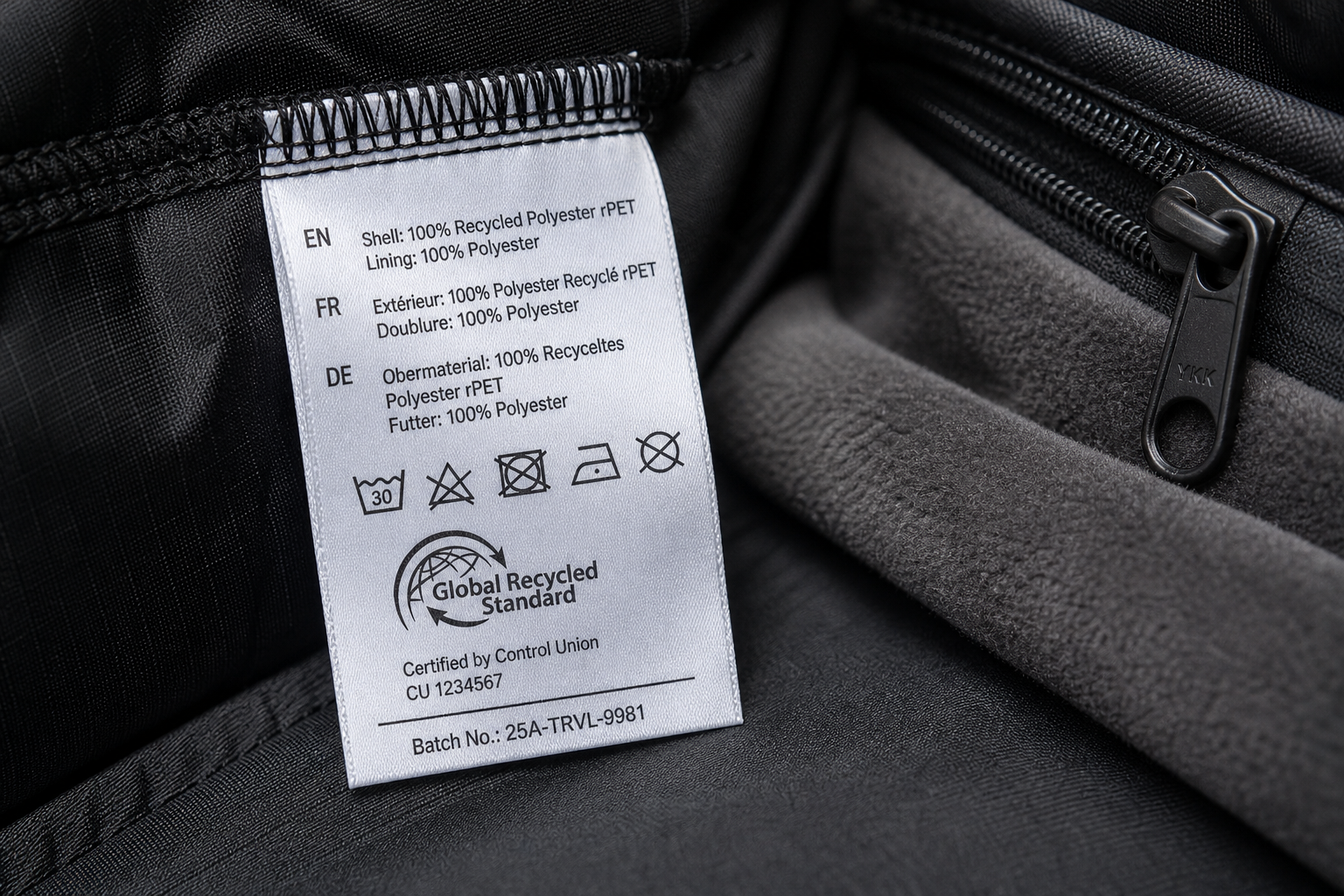
Care symbols, language and country of origin
Care symbols
The five GINETEX symbols cover washing, bleaching, drying, ironing and professional care, with a cross over any treatment that must not be used. Most laptop backpacks take a spot-clean-only instruction, which means a wash symbol with a cross, no bleach, no tumble dry, no iron and no professional dry clean unless the trim set allows it.
The symbol set is graphic, so it crosses language boundaries. That is exactly why retailers accept it and why a symbol omission is so visible on an audit.
Language requirements per member state
The fibre content declaration has to be available in the official language of the member state where the product is sold. There is no single EU language for the label, so a multi-country launch needs either a multi-language label or a market-specific label per country.
Practical approach we use for EU programs: a multi-language care and composition label covering English, French, German, Dutch, Italian and Spanish on one label, with the country-specific mandatory warning text added only where the destination requires it. For a single-country launch, one language is cheaper and cleaner.
Country of origin
State it as produced in China where the bag is manufactured in our Quanzhou facility, in wording that matches the customs declaration. A label that says Designed in Europe beside a genuine origin of China is a misdeclaration risk, and customs authorities treat origin wording as a declaration, not as marketing.
The label approval checklist before bulk
Run this before the bulk cutting release, not after the labels arrive.
Fibre declaration per textile part, with official fibre names and figures adding to 100
Composition figures traced to the actual mill run and to the fibre test report on file
Care symbol set matching the lowest-tolerance component in the bag, not the shell alone
Country of origin wording identical to the wording on the customs documentation
Language set covering every member state in the shipping plan
Size and position requirements met, including durability against 10 normal washes of rubbing or use
Label artwork approved in writing by the buyer, with a version number and a date
Packaging and hangtag text checked against the same language and origin rules
That seventh row is the one that saves orders. An unapproved label version is the single most common cause of a label-related hold we see.
Six label errors that trigger retail rejection
Fibre names that are not on the official list, or that use a brand name instead of a fibre name
Percentages that do not add to 100, or that omit a textile part such as the strap webbing
Care symbols missing entirely, or copied from a garment with a different trim set
Origin wording absent, or in conflict with the customs declaration
One language only, on an order shipping to three markets
Composition declared from the sample and not updated after a mill or material change
At Tianqin, the composition line on the label is generated from the same material code used in production, and a material change locks the label file until someone re-approves it. That is a deliberate bottleneck. It costs us a day on some orders.
Honest limitation: we can control the label we print. We cannot guarantee that a marketplace listing, a retail website or a distributor's own printed catalogue repeats the composition correctly once the goods leave us. Where a buyer sells through third-party channels, the listing text needs the same review as the physical label.
Fix the label pack before you cut bulk
Treat the label, the hangtag and the packaging as one artwork file with one version number, and require written approval at least 15 working days before bulk cutting starts. That is enough time to reprint if a language or a composition line is wrong, and not enough time if you discover it after the labels are sewn in.
Send your shipping plan, member state list and bill of materials to [email protected]. We will return a draft label layout with fibre declarations and care symbols for your review. Sampling turnaround is 7 to 15 business days, and our product and factory details are at www.tianqinbag.com.




 Hot News


