
 EN



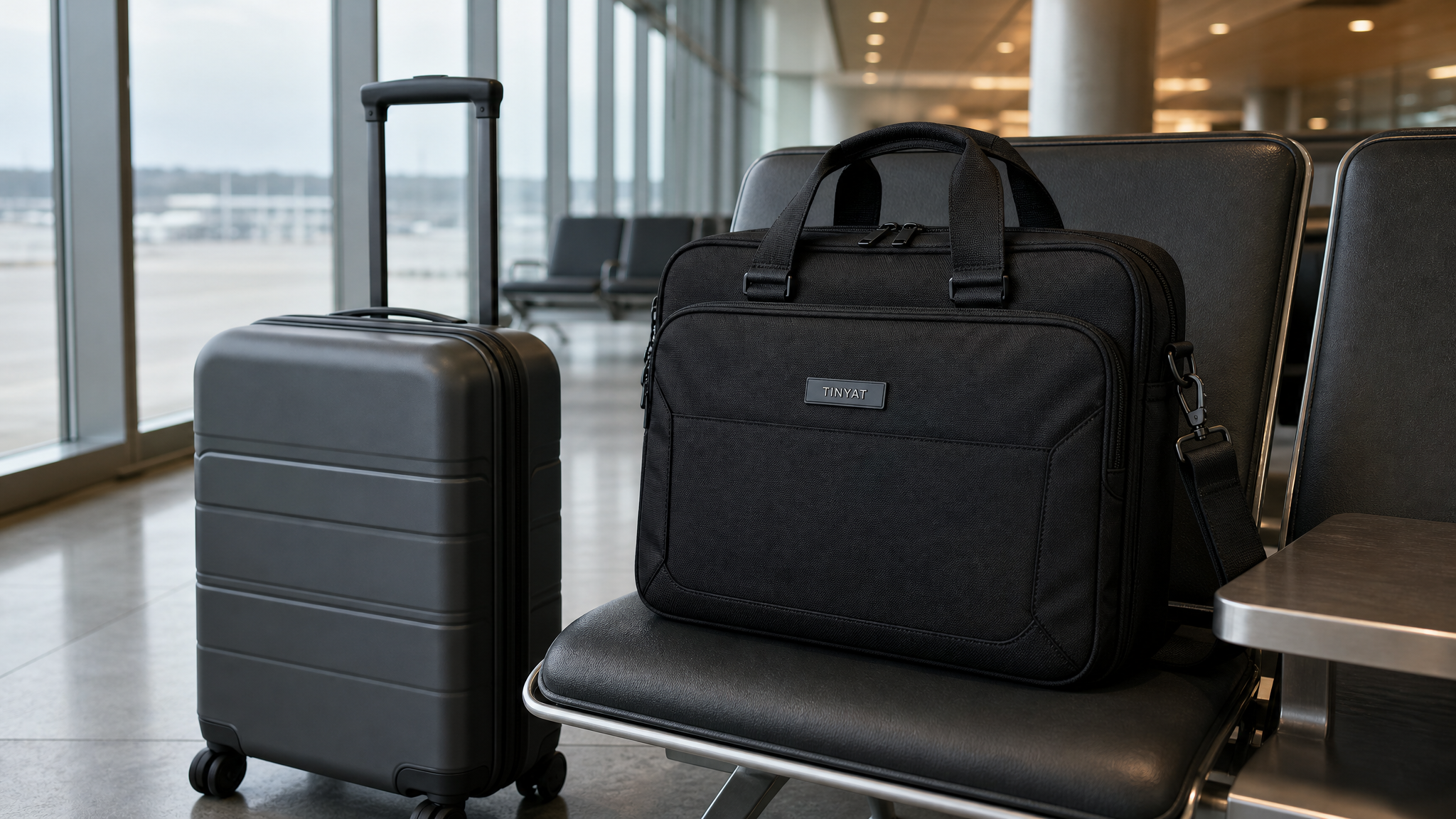
At the security lane the tray is the constraint. The device has to come out of the bag and lie flat, and a bag that cannot open flat slows the queue behind the person using it. That single moment drives two design decisions in travel luggage. A custom travel laptop bag manufacturer has to build both, because a trolley sleeve that fits the case and a bag that opens flat at a checkpoint are separate problems with separate failure modes.
Two Problems, One Bag
Travel is a sequence of handovers between the bag and other objects: a cabin trolley handle, a security tray, an overhead bin, a seat pocket, a hotel desk. Each handover puts a specific load on a specific seam.
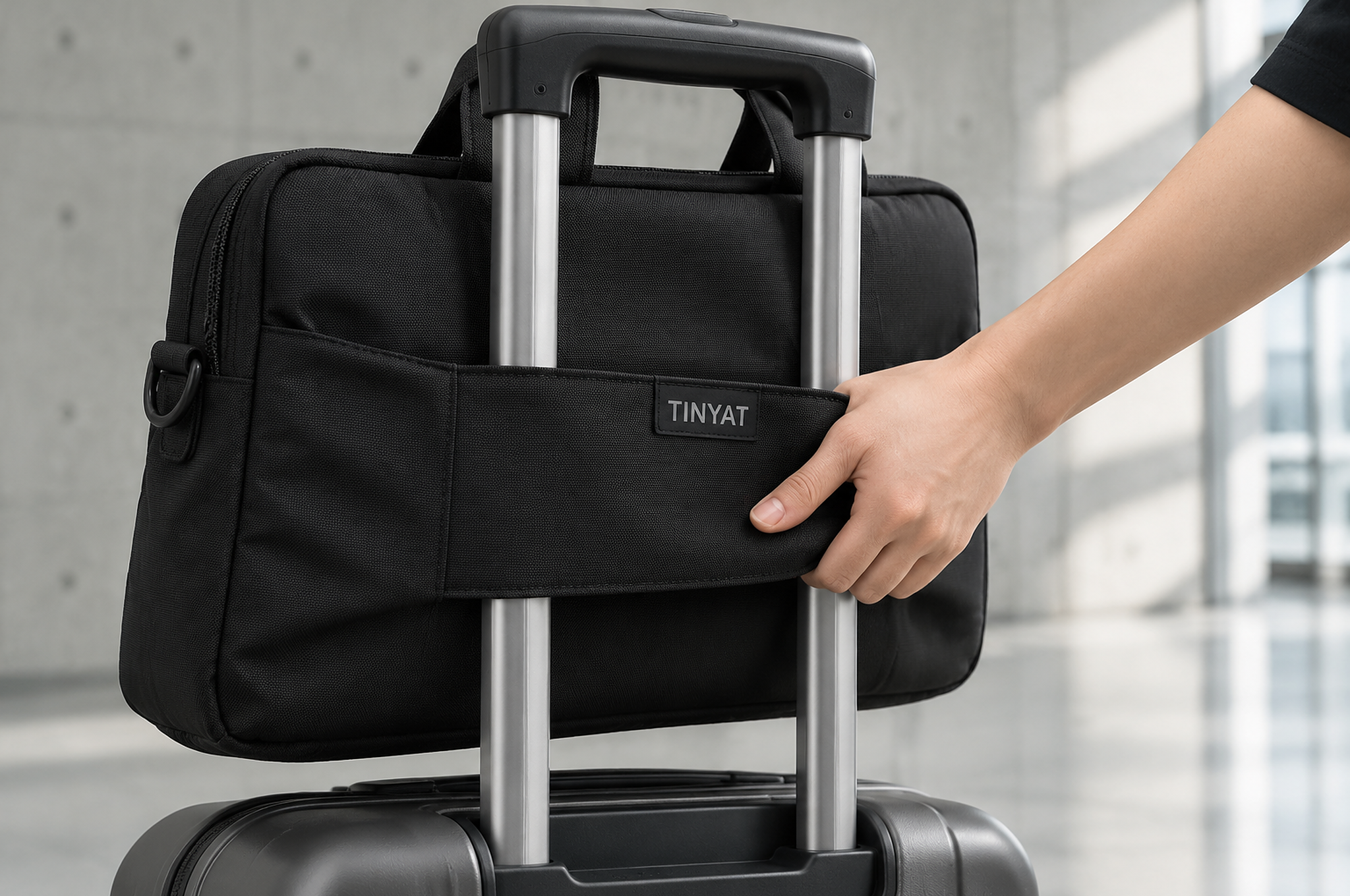
The trolley sleeve is loaded in two directions. Downward, by the bag's own weight hanging on the handle bars, and sideways, by the bag swinging as the case is wheeled. Both loads land on the sleeve's side seams, and a sleeve that is only a fabric tube sewn to the back panel will tear at the top corners within a season of airport use.
The checkpoint opening is loaded differently. Every time the bag folds open it works the hinge at the base of the design, and every landing on a tray puts the weight of the bag on that hinge. That is a cycle load rather than a single impact, so it needs a fatigue answer rather than a strength answer.
The Trolley Sleeve As A Mechanical Part
Treat the sleeve as hardware rather than trim, and the specification becomes concrete.
Sleeve facing: 1680D ballistic nylon on the two wear surfaces, since the handle bars rub on every use
Opening: 205 mm wide, which gives about 195 mm of clear width once seam allowances are taken
Depth: 120 mm, deep enough that the bag does not rock on the case
Side seams: double stitched and bar-tacked at the top corners, where the load concentrates
Reinforcement: a 2 mm board strip behind the sleeve facing, so the bars press on a flat surface rather than on fabric alone
Closure: a zip or a magnetic flap so the sleeve lies flat when it is not in use
Most telescopic handles run 200 to 215 mm wide with bars of 22 to 26 mm, so a sleeve with 185 mm of clear width will not go on. We test every travel program on a case with a 205 mm handle and 25 mm bars, because a sleeve that fits one suitcase and not the next is a complaint waiting for a review.
Our practice is to recess the sleeve seam so its top edge sits below the lumbar line. That moves the load on the trolley handle about 40 mm lower, which makes the bag more stable on the case, and it stops the wearer's back contacting a seam when the bag is carried instead.
What the sleeve does to the back panel
A sleeve is not free structure. It adds a layer between the wearer and the padding, so the back panel underneath still needs spacer mesh against the body, then foam, then the sleeve.
Checkpoint Design: What Flat-Open Actually Requires
A bag that opens flat at a checkpoint is a construction, not a claim.
The device compartment has to be able to lie open on the tray with the device visible and reachable, which means the opening runs on three sides and the bag folds at a hinge along the base. The device sleeve then sits on one of the two open faces, held by a strap or a flap so it does not slide out while the bag is being opened.
Three details decide whether it works in a queue.
Hinge: at least 500 N pull on each hinge end, with a 25 mm bar-tack, since the fold takes the bag's loaded weight
Opening clearance: 15 mm of extra panel beyond the device sleeve, so a hand can reach the device without pulling the bag open further
Retention: a hook-and-loop strap or a flap over the device, so the bag can be lifted by one half without the device falling
The honest position on checkpoint claims is worth stating. No authority certifies a bag as checkpoint friendly, and the term is a marketing description rather than a standard. What a buyer can promise is that the bag opens flat and the device is accessible without unpacking, which is a construction fact rather than a regulatory one.
What A Custom Travel Laptop Bag Manufacturer Verifies
Travel programs get four checks that other laptop bags do not need.
Trolley fit: the sleeve on a case with a 205 mm handle and 25 mm bars, photographed from above
Sleeve load: 400 N pull on the sleeve seams, plus 200 cycles of on and off with 4 kg in the bag
Fold cycle: 550 open and close cycles on the checkpoint hinge with a 2 kg load
Device retention: bag lifted by one half with the device in place, no movement beyond 10 mm
Sleeve abrasion: 500 cycles against a handle bar, checking the facing for wear through
Zip: 3,000 cycles on the main opening, since this opening is used at every checkpoint
The on and off test finds the real problems. A tight sleeve passes a static fit check and fails at cycle 60, because each removal drags the facing against the bars at the weakest point of the seam.
Where travel features cost you
A trolley sleeve with 1680D facing, board reinforcement, bar-tacked corners, and a zip closure adds about 0.42 USD and 85 g to a laptop bag. A flat-open checkpoint construction with a hinge and reinforced ends adds about 0.55 USD and 70 g, plus 6 to 9 minutes of sewing labour per bag.
Below roughly 6.50 USD FOB at 1,000 units, a bag can have one of the two features properly, not both. Buyers usually choose the sleeve, because it is visible in a product photograph and the checkpoint design is not. That is a defensible commercial choice, and it is worth making knowingly rather than discovering at the sample stage that both were assumed.
What the buyer sees at the security lane
From your side, the test takes ninety seconds and happens in public. Put a device in the bag, open it flat on a tray, pick the bag up by one half, and see whether the device stays where you left it. Then lift the bag off the trolley by the handle, one handed, and watch whether the sleeve corners fold or the bag swings off centre. Those two moments are what the customer will remember about the product.
A Travel Feature Sheet
Send these lines with a travel brief.
Sleeve opening: 205 mm wide, 195 mm clear after seam allowance
Sleeve depth: 120 mm
Sleeve facing: 1680D ballistic nylon with a 2 mm board strip
Sleeve seams: double stitched, bar-tacked top corners, 400 N pull gate
Sleeve closure: zip, so it lies flat when unused
Sleeve position: seam recessed below the lumbar line
Checkpoint hinge: 500 N pull per end, 25 mm bar-tack, 550 fold cycles
Opening clearance: 15 mm beyond the device sleeve
Device retention: strap or flap, movement under 10 mm when lifted by one half
Hardware: welded 4 mm D-rings on the shoulder strap
Weight impact: plus 155 g for both features
Verification: trolley fit photograph plus fold cycle record
That weight line matters on a travel program, because the customer is already carrying a device and a charger and notices every additional 100 g.
Send The Case And The Device
Tell us which suitcase your customer uses, or the handle width if you know it, and the device you need the bag to hold. We will build the sleeve to that handle geometry, verify the fold on a loaded sample, and quote the sleeve and checkpoint features separately so you can see what each one costs.
Contact [email protected] or visit www.tianqinbag.com to request samples, get a factory quote, or start an OEM/ODM project with Quanzhou Tianqin Bags Co., Ltd. Sampling lead time is 7-15 working days, and travel samples are tested on a case before they ship. Seventeen years of bag manufacturing in Quanzhou, exports to more than 50 countries, SGS test reports covering REACH, CPSIA and Prop 65 on request.


 Hot News


