EN



A brand asks us for 120 units of a new 25 litre laptop backpack. Our quote comes back at 18.60 USD per unit. At 1,000 units the same bag is 9.40. Read alone, that looks like a 98 percent penalty for ordering small. Almost all of the gap is 1,150 USD of setup work that has to be paid by somebody, and at 120 units it is paid 120 times over.
The Setup Costs That Do Not Care About Quantity
These are the lines a factory books before the first bulk bag exists, and none of them shrink because you ordered fewer.
Pattern making and size grading: 180 USD
Marker and cut file for our automated cutter: 60 USD
Clicking dies for foam panels, stiffeners and the laptop sleeve: 240 USD
Logo tooling, silicone emboss or heat transfer plate: 150 USD
Hangtag and carton print plates: 105 USD
First prototype plus one revision round: 250 USD
Line trial and first article approval: 120 USD
Sample shipment to you: 45 USD
That is 1,150 USD. Spread it across the order and the arithmetic is unforgiving. At 120 units it adds 9.58 per bag. At 300 units, 3.83. At 500, 2.30. At 1,000, 1.15. At 3,000, 0.38. Add the conversion cost of making the bag, roughly 9.00 at small volume, and the 18.60 quote stops looking arbitrary.
A buyer asked us once whether we were charging for the sample twice. We were not. The sample fee covers the prototype and the courier. The pattern, the dies and the plates are separate assets that stay with the program, which is why we amortise them instead of hiding them.
Where the Curve Actually Flattens
Volume discounts are not linear, and suppliers who offer a flat 5 percent for every doubling are guessing.
50 to 150 units: 1.7 to 2.2 times the 1,000 unit price
150 to 300 units: 1.35 to 1.65 times
300 to 800 units: 1.08 to 1.30 times
800 to 1,500 units: 1.00 to 1.06 times
1,500 to 3,000 units: 0.94 to 0.97 times
Above 3,000 units: 0.92 to 0.93 times, then flat
The knee sits between 300 and 500. Above 800 the curve is nearly horizontal, and further savings come from fabric tier, carton optimisation and payment terms rather than from quantity. A buyer pushing from 3,000 to 6,000 for another 1 percent is usually negotiating the wrong variable.
The flat section hides one jump. At around 1,500 units it becomes worth buying fabric in full roll quantities instead of part rolls, and the price per metre can fall 4 to 6 percent. That is a bigger effect than any labor saving at the same volume, and it is a material saving wearing a volume costume.
Why Below 300 Units Hurts More Than the Math Suggests
The amortisation number is the visible cost. Four others sit behind it.
Fabric minimums are the hard wall. Custom dyed 1680D ballistic carries a dye lot minimum around 500 metres per colour. A 120 unit order uses 98 metres. We still buy the lot, and 400 metres of that colour sits on our rack as remnant, ageing, until someone else orders it or we write part of it off. A 300 unit order uses 246 metres and the remnant is half the size.
Zipper and hardware minimums behave the same way. YKK chain and slider colours come in pack quantities, and a hardware plating run has its own minimum. At 120 units we are buying full packs to pull a fraction.
Changeover costs 45 to 70 minutes of stopped line time, every time the style changes. On a 1,000 unit run that is negligible. On a 120 unit run it is a visible share of the labor.
Operator rhythm is real and measurable. On a 1,000 unit run, output on day four is 10 to 12 percent higher than day one for the same team on the same style. On a 120 unit run there is no day four.
Inspection is largely fixed per lot. An AQL II inspection costs what it costs whether the lot is 150 pieces or 1,500, so the per-unit inspection cost at the low end can be three times higher.
Payment terms are the fifth and least discussed. A 120 unit order is usually paid 30 percent deposit and 70 percent on shipment, and we carry the fabric purchase for about 45 days between the two. On a 1,000 unit order that exposure is spread far more thinly, so the financing cost per bag drops. It is small in absolute terms, 0.10 to 0.25 USD per unit, but it is real and it will not move because you argue about labor minutes.
What We Do With Small Orders, and What We Decline
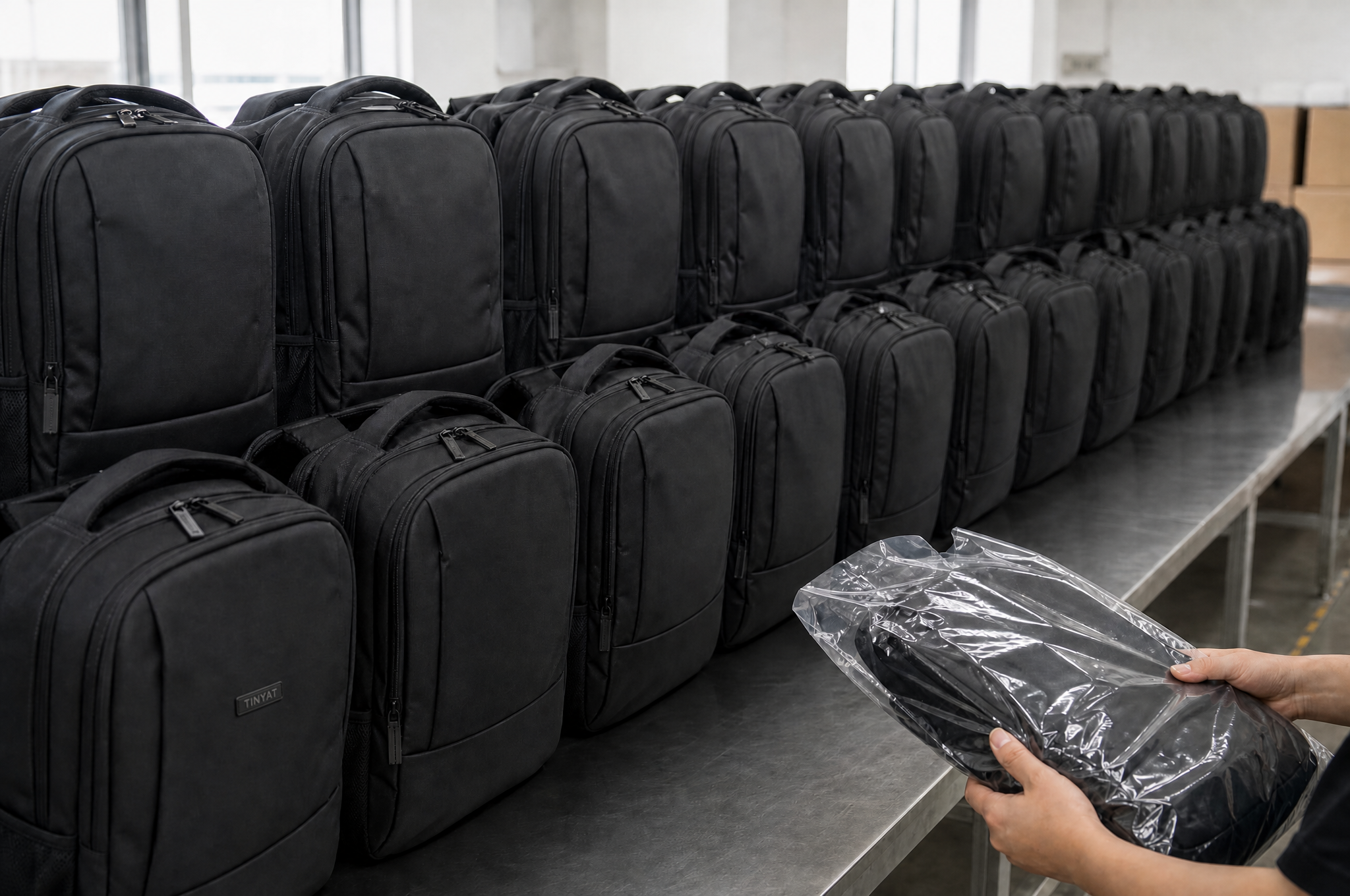
We quote from 150 units on a new style. We add a small-lot surcharge of 8 to 12 percent, we do not reserve fabric at that quantity, and we run the order on a flexible line rather than tying up a main line slot.
The limitation is worth stating plainly. Below 100 units of a new style we usually decline, not because we cannot sew it, but because the setup and the fabric remnant make the true price higher than any buyer will accept, and a quote nobody accepts wastes both sides' week. Above 100 units we will always give a number.
Our suggestion to brands testing a design: order 150 units in one colourway rather than 150 units across three. Colour splits are what turn a workable small order into an expensive one, because each colour carries its own minimum.
Six Questions That Decide Your Real MOQ
Work through these before you negotiate on price.
What is the total setup cost, listed item by item, and which items recur on a reorder
What is the unit price at three quantities, not two
Is the fabric a stock colour or a custom dye lot, and what is its minimum
Are all zippers and hardware available at the quantity you are ordering
Is there a small-lot surcharge, and at what quantity does it disappear
What is the reorder MOQ, given the pattern and dies already exist
That last question matters most for planning. On a reorder of an approved style, setup drops to a marker refresh and a line trial, and our reorder MOQ falls to about 200 units. Brands that intend to scale should ask for both numbers at the first quote.
A note on colour splits, because they cause most of the pain. Three colourways at 150 units each means three dye lots, three zipper colour packs and three small print runs. One colourway at 450 units means one of each, and the unit price can land 12 to 18 percent lower for an identical bag. Much of what buyers experience as a small order problem is really a complexity problem.
Send Your Quantity and Your Target Price
Send us your target quantity, your target FOB price and your launch date. We will send the price at your quantity, the price at the next break, and the setup list so you can see which line is doing the damage.
Quanzhou Tianqin Bags Co., Ltd has manufactured bags for 17 years, runs OEM and ODM programs for buyers in more than 50 countries, and builds on automated cutting, a hanging conveyor and semi-automated assembly lines. Sampling takes 7-15 working days, which means a 150 unit test run can be in your hands before a season closes.
Email [email protected] or visit www.tianqinbag.com and tell us the quantity you can actually commit to. We will quote it honestly, including the small-lot surcharge, rather than quoting 120 units at a price we would have to renegotiate later.

 Hot News